
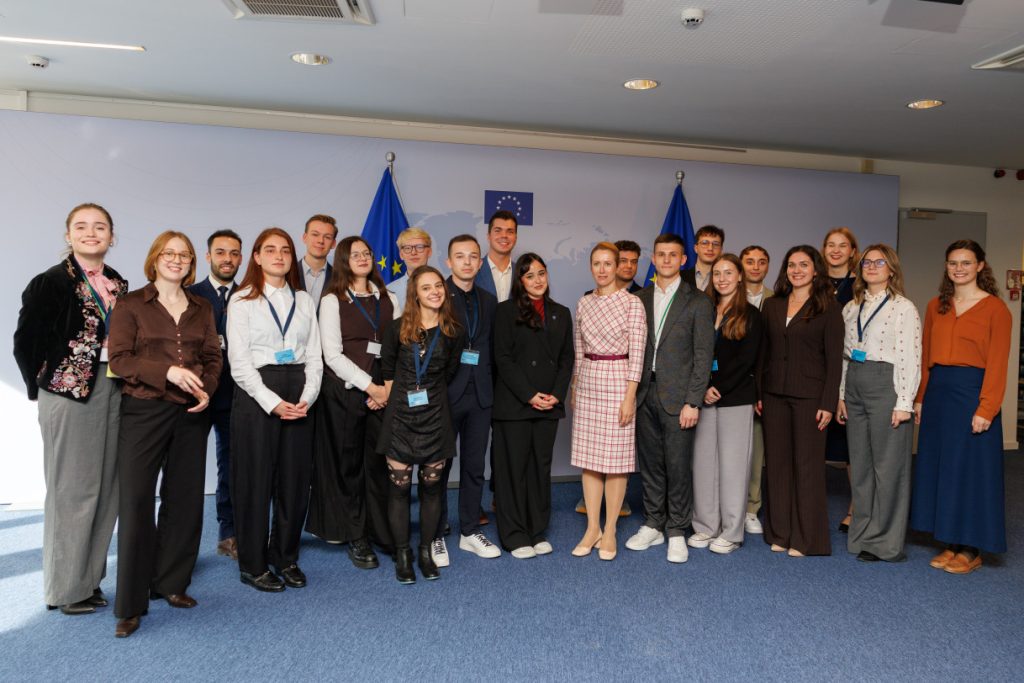
Young people from the Western Balkans and across Europe brought their perspectives directly into EU foreign policy discussions in Brussels on 14 October, meeting EU High Representative for Foreign Affairs and Security Policy and Vice-President of the European Commission Kaja Kallas as part of the Youth Policy Dialogue.
Twenty young participants from the Western Balkans, EU Member States, Georgia, Ukraine, the United Kingdom, Iceland and Norway took part in the exchange, presenting recommendations developed through earlier discussions in Montenegro.
The meeting gave young people an opportunity to discuss some of the major foreign and security policy challenges facing Europe and to bring their ideas directly to the EU’s High Representative.
From the Western Balkans to Brussels
The Brussels meeting followed a two-day Youth Policy Dialogue held in Budva, Montenegro, in June, alongside the EU-Western Balkans Summit.
During the earlier dialogue, young participants worked together on a position paper examining three main themes: the EU’s role as a reliable geopolitical partner; the role of young people in peace, security and reconciliation; and responses to disinformation and foreign information manipulation and interference (FIMI).
Their recommendations were brought to Brussels for further discussion with Kaja Kallas, creating a direct link between youth-led discussions and EU-level policymaking.
The initiative was organised in collaboration with the Regional Youth Cooperation Office’s Western Balkans Youth Forum, held within the framework of the Berlin Process.
Youth voices in peace, security and reconciliation
The dialogue builds on broader efforts to strengthen young people’s participation in decisions affecting Europe’s security and future.
This year’s Western Balkans Youth Forum brought together more than 220 participants in Budva, including over 100 young people from across the region. Discussions addressed peace and security, democratic participation, skills and innovation, sustainability and regional cooperation.
Among their recommendations, participants called for stronger youth participation in decision-making, a regional approach to Youth, Peace and Security, greater emphasis on civic and peace education, media literacy and critical thinking, and continued efforts to counter disinformation and hate speech.
Regional youth cooperation also remains an important part of the Berlin Process, which brings together the six Western Balkan partners, EU institutions and participating European governments to support regional cooperation and European integration.
Bringing young people closer to EU policymaking
The Brussels dialogue provided an opportunity to take ideas developed through regional youth cooperation into a direct exchange with EU decision-makers.
For young people from the Western Balkans, participation in these discussions also strengthens connections with their peers across Europe and creates opportunities to contribute to debates on peace, security, reconciliation and Europe’s future.
Youth Policy Dialogues are designed to give young people a direct voice in EU foreign and security policy, ensuring their experiences and priorities can contribute to discussions shaping Europe’s response to shared challenges.


