
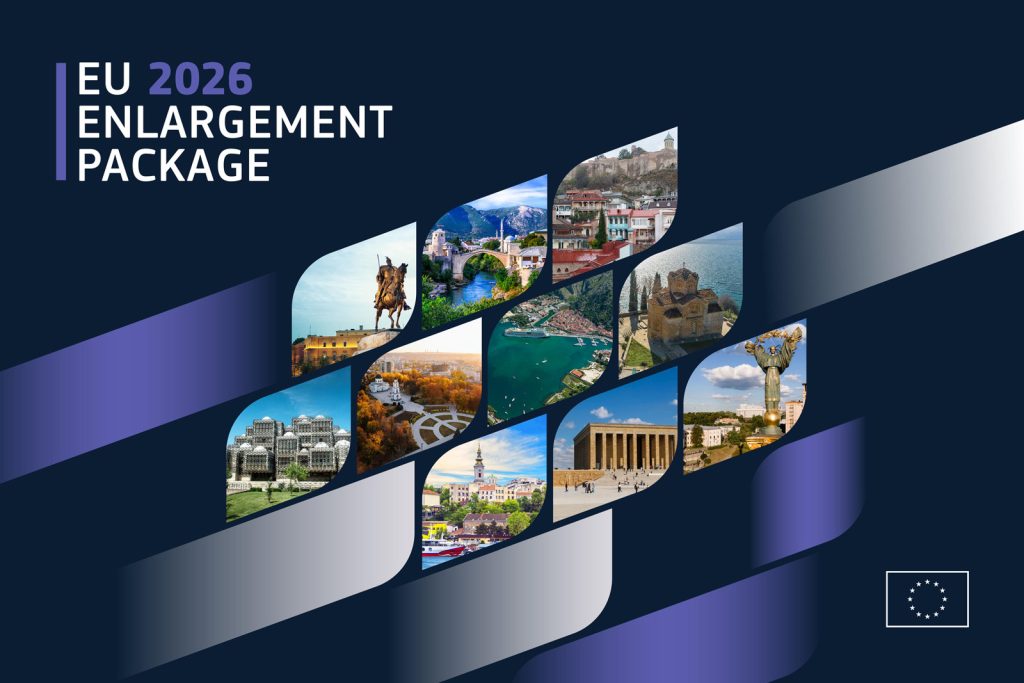
The European Commission presented its annual Enlargement Package today, highlighting progress made by enlargement partners over the past year and outlining the reforms needed to advance towards European Union membership.
The 2026 Enlargement Package confirms that sustained reform efforts can translate into concrete progress, particularly for Montenegro and Albania, which remain among the most advanced partners in the accession process.
The Commission also presented indicative accession roadmaps for Montenegro, Albania, Moldova and Ukraine, setting out milestones for the year ahead. The assessments underline the importance of democratic institutions, the rule of law, fundamental rights and continued alignment with EU standards.
Key developments for the Western Balkans
Montenegro
Montenegro has made significant progress towards EU membership, having provisionally closed 21 negotiating chapters. According to the Commission, the remaining chapters could be provisionally closed by the end of 2026, subject to agreement among EU Member States. Work on Montenegro’s accession treaty is already underway, bringing the partner closer to the final stages of the accession process. Continued reforms and broad political consensus remain essential.
Albania
Albania continued advancing its accession negotiations, opening its final remaining negotiating cluster and meeting the interim benchmarks on the rule of law chapters. These developments paved the way for the provisional closure of four negotiating chapters. The Commission considers Albania’s objective of concluding accession negotiations by 2027 ambitious but achievable, provided reform momentum and constructive political dialogue are maintained.
Bosnia and Herzegovina
Bosnia and Herzegovina continues to identify EU integration as a strategic objective, although the Commission noted a slowdown in reform implementation and increasing political challenges. Following the recent elections, renewed institutional cooperation and progress on EU-related reforms will be essential. The Commission also encouraged the authorities to take the necessary steps to fully benefit from the partner’s Reform Agenda under the Reform and Growth Facility.
Kosovo
Kosovo recorded some progress in tackling serious and organised crime and maintained full alignment with the EU’s Common Foreign and Security Policy. Following developments in local governance in northern Kosovo, the Commission lifted its measures against Kosovo, allowing renewed engagement through the Stabilisation and Association Process Dialogue and the resumption of financial assistance. Further progress on democratic institutions, fundamental rights and EU-related reforms remains necessary.
North Macedonia
North Macedonia continued working on reforms linked to the fundamentals of the accession process, including the adoption of a roadmap for public administration reform. The Commission also highlighted significant progress in implementing its Reform Agenda, making North Macedonia one of the strongest performers under the Reform and Growth Facility. Further progress on the rule of law, negotiating benchmarks and the necessary constitutional amendments remains important for advancing accession negotiations.
Serbia
Serbia continued technical work on aligning its legislation and standards with those of the European Union. However, the Commission reported no substantive progress in accession negotiations during the reporting period and highlighted concerns regarding democratic institutions, fundamental rights and political polarisation. Renewed reform efforts, stronger alignment with EU foreign and security policy, and continued engagement in the EU-facilitated Dialogue will be important for further progress.
Supporting reforms and closer EU integration
Alongside the individual assessments, the Commission presented a framework to strengthen the gradual integration of enlargement partners into EU policies, particularly in strategic areas such as energy, transport, digital transformation and defence.
For the Western Balkans, the EU Growth Plan, backed by the €6 billion Reform and Growth Facility for 2024–2027, continues to support economic convergence, regional cooperation and closer integration with the EU Single Market.
The Commission will also launch dialogues with enlargement partners over the next six months to identify further opportunities for gradual integration, allowing citizens and businesses to benefit from closer cooperation with the EU ahead of membership.
Looking ahead
The 2026 Enlargement Package reaffirms the European Union’s commitment to a merit-based enlargement process, with progress depending on the implementation of reforms and the fulfilment of accession requirements.
The European Commission’s recommendations will now be considered by the Council of the EU, which will decide on the next steps in the enlargement process.
Read the individual country reports and factsheets
The European Commission has published detailed assessments and country factsheets as part of the 2026 Enlargement Package. These provide further information on progress achieved, outstanding challenges and reform priorities for each Western Balkan partner.
- Montenegro: 2026 Report and recommendations | Country factsheet
- Albania: 2026 Report and recommendations | Country factsheet
- Bosnia and Herzegovina: 2026 Report and recommendations | Country factsheet
- North Macedonia: 2026 Report and recommendations | Country factsheet


