
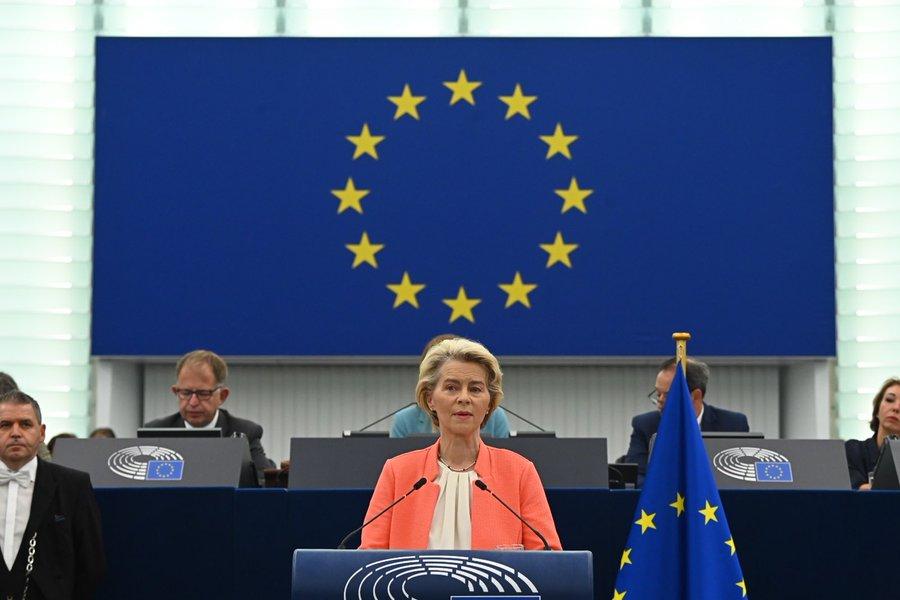
ANSWERING THE CALL OF HISTORY
INTRODUCTION – DELIVER TODAY, PREPARE FOR TOMORROW
Honourable Members,
In just under 300 days, Europeans will take to the polls in our unique and remarkable democracy.
As with any election, it will be a time for people to reflect on the State of our Union and the work done by those that represent them.
But it will also be a time to decide on what kind of future and what kind of Europe they want.
Among them will be millions of first-time voters, the youngest of whom were born in 2008.
As they stand in that polling booth, they will think about what matters to them.
They will think about the war that rages at our borders.
Or the impact of destructive climate change.
About how artificial intelligence will influence their lives.
Or of their chances of getting a house or a job in the years ahead.
Our Union today reflects the vision of those who dreamt of a better future after World War II.
A future in which a Union of nations, democracies and people would work together to share peace and prosperity.
They believed that Europe was the answer to the call of history.
When I speak to the new generation of young people, I see that same vision for a better future.
That same burning desire to build something better.
That same belief that in a world of uncertainty, Europe once again must answer the call of history.
And that is what we must do together.
Honourable Members,
This starts with earning the trust of Europeans to deal with their aspirations and anxieties.
And in the next 300 days we must finish the job that they entrusted us with.
I want to thank this House for its leading role in delivering on one of the most ambitious transformations this Union has ever embarked on.
When I stood in front of you in 2019 with my programme for a green, digital and geopolitical Europe I know that some had doubts.
And that was before the world turned upside down with a global pandemic and a brutal war on European soil.
But look at where Europe is today.
We have seen the birth of a geopolitical Union – supporting Ukraine, standing up to Russia’s aggression, responding to an assertive China and investing in partnerships.
We now have a European Green Deal as the centrepiece of our economy and unmatched in ambition.
We have set the path for the digital transition and become global pioneers in online rights.
We have the historic NextGenerationEU – combining 800 billion euros of investment and reform – and creating decent jobs for today and tomorrow.
We have set the building blocks for a Health Union, helping to vaccinate an entire continent – and large parts of the world.
We have started making ourselves more independent in critical sectors, like energy, chips or raw materials.
I would also like to thank you for the ground-breaking and pioneering work we did on gender equality.
As a woman, this means a lot to me.
We have concluded files that many thought would be blocked forever, like the Women on Boards Directive and the historic accession of the EU to the Istanbul Convention.
With the Directive on pay transparency we have cast into law the basic principle that equal work deserves equal pay.
There is not a single argument why – for the same type of work – a woman should be paid less than a man.
But our work is far from over and we must continue pushing for progress together.
I know this house supports our proposal on combating violence against women.
Here too, I would like that we cast into law another basic principle: No, means no.
There can be no true equality without freedom from violence.
And thanks to this Parliament, to Member States and to my team of Commissioners, we have delivered over 90% of the Political Guidelines I presented in 2019.
Together, we have shown that when Europe is bold, it gets things done.
And our work is far from over – so let’s stand together.
Let’s deliver today and prepare for tomorrow.
EUROPEAN GREEN DEAL
Honourable Members,
Four years ago, the European Green Deal was our answer to the call of history.
And this summer – the hottest ever on record in Europe – was a stark reminder of that.
Greece and Spain were struck by ravaging wildfires – and were hit again only a few weeks later by devastating floods.
And we saw the chaos and carnage of extreme weather – from Slovenia to Bulgaria and right across our Union.
This is the reality of a boiling planet.
The European Green Deal was born out of this necessity to protect our planet.
But it was also designed as an opportunity to preserve our future prosperity.
We started this mandate by setting a long-term perspective with the climate law and the 2050 target.
We shifted the climate agenda to being an economic one.
This has given a clear sense of direction for investment and innovation.
And we have already seen this growth strategy delivering in the short-term.
Europe’s industry is showing every day that it is ready to power this transition.
Proving that modernisation and decarbonisation can go hand in hand.
In the last five years, the number of clean steel factories in the EU has grown from zero to 38.
We are now attracting more investment in clean hydrogen than the US and China combined.
And tomorrow I will be in Denmark with Prime Minister Mette Frederiksen to see that innovation first hand.
We will mark the launch of the first container ship, powered by clean methanol made with solar energy.
This is the strength of Europe’s response to climate change.
The European Green Deal provides the necessary frame, incentives, and investment – but it is the people, the inventors, the engineers who develop the solutions.
And this is why, Honourable Members,
as we enter the next phase of the European Green Deal, one thing will never change.
We will keep supporting European industry throughout this transition.
We started with a package of measures – from the Net-Zero Industry Act to the Critical Raw Materials Act.
With our Industry Strategy, we are looking at the risks and needs of each ecosystem in this transition.
We need to finish this work.
And with this, we need to develop an approach for each industrial ecosystem.
Therefore, starting from this month, we will hold a series of Clean Transition Dialogues with industry.
The core aim will be to support every sector in building its business model for the decarbonisation of industry.
Because we believe that this transition is essential for our future competitiveness in Europe.
But this is just as much about the people and their jobs of today.
Our wind industry, for instance, is a European success story.
But it is currently facing a unique mix of challenges.
This is why we will put forward a European Wind Power package – working closely with industry and Member States.
We will fast-track permitting even more.
We will improve the auction systems across the EU.
We will focus on skills, access to finance and stable supply chains.
But this is broader than one sector:
From wind to steel, from batteries to electric vehicles, our ambition is crystal clear: The future of our clean tech industry has to be made in Europe.
Honourable Members,
This shows that when it comes to the European Green Deal:
We stay the course.
We stay ambitious.
We stick to our growth strategy.
And we will always strive for a fair and just transition!
That means a fair outcome for future generations – to live on healthy planet.
And a fair journey for all those impacted – with decent jobs and a solemn promise to leave no one behind.
Just think about manufacturing jobs and competitiveness: a topic we are discussing a lot these days.
Our industry and tech companies like competition.
They know that global competition is good for business.
And that it creates and protects good jobs here in Europe.
But competition is only true as long as it is fair.
Too often, our companies are excluded from foreign markets or are victims of predatory practices.
They are often undercut by competitors benefitting from huge state subsidies.
We have not forgotten how China’s unfair trade practices affected our solar industry.
Many young businesses were pushed out by heavily subsidised Chinese competitors.
Pioneering companies had to file for bankruptcy.
Promising talents went searching for fortune abroad.
This is why fairness in the global economy is so important – because it affects lives and livelihoods.
Entire industries and communities depend on it.
So, we have be to be clear-eyed about the risks we face.
Take the electric vehicles sector.
It is a crucial industry for the clean economy, with a huge potential for Europe.
But global markets are now flooded with cheaper Chinese electric cars.
And their price is kept artificially low by huge state subsidies.
This is distorting our market.
And as we do not accept this from the inside, we do not accept this from the outside.
So I can announce today that the Commission is launching an anti-subsidy investigation into electric vehicles coming from China.
Europe is open for competition. Not for a race to the bottom.
We must defend ourselves against unfair practices.
But equally, it is vital to keep open lines of communication and dialogue with China.
Because there also are topics, where we can and have to cooperate.
De-risk, not decouple – this will be my approach with the Chinese leadership at the EU-China Summit later this year.
Honourable Members,
In the European Union, we are proud of our cultural diversity.
We are a ‘Europe of the Regions’ with a unique blend of languages, music, art, traditions, crafts and cuisines.
We are also a continent of unique biological diversity.
Some 6 500 species are found only in Europe.
In northern Europe, we find the Wadden Sea, a world natural heritage site and unique habitat offering a home to rare species of flora and fauna and a vital resource for millions of migratory birds. And with the Baltic Sea we have the largest area of brackish sea in the world.
South of that is the European Plain, characterised by vast tracts of moorland and wetland.
These regions are important allies against ongoing climate change.
Protected moors and wetlands absorb enormous volumes of greenhouse gases, secure regional water cycles and are home to unique biodiversity.
And Europe is a continent of forests.
From the mighty coniferous forests of the North and East, via the last remnants of virgin oak and beech forest in central Europe to the cork oak forests of southern Europe: all these forests are an irreplaceable source of goods and services.
They absorb carbon dioxide, supply wood and other products, generate fertile soils, and filter the air and the water.
Biodiversity and ecosystem services are vital for all of us in Europe.
Loss of nature destroys not only the foundations of our life, but also our feeling of what constitutes home.
We must protect it.
At the same time, food security, in harmony with nature, remains an essential task.
I would like to take this opportunity to express my appreciation to our farmers, to thank them for providing us with food day after day.
For us in Europe, this task of agriculture – producing healthy food – is the foundation of our agricultural policy.
And self-sufficiency in food is also important for us.
That is what our farmers provide.
It is not always an easy task, as the consequences of Russia’s aggression against Ukraine, climate change bringing droughts, forest fires and flooding, and new obligations are all having a growing impact on farmers’ work and incomes.
We must bear that in mind.
Many are already working towards a more sustainable form of agriculture.
We must work together with the men and women in farming to tackle these new challenges.
That is the only way to secure the supply of food for the future.
We need more dialogue and less polarisation.
That is why we want to launch a strategic dialogue on the future of agriculture in the EU.
I am and remain convinced that agriculture and protection of the natural world can go hand in hand.
We need both.
ECONOMY, SOCIAL AND COMPETITIVENESS
Honourable Members,
A fair transition for farmers, families and industry.
This is the hallmark of this Mandate.
And it is all the more important as we face strong economic headwinds.
I see three major economic challenges for our industry in the year ahead: labour and skills shortages, inflation, and making business easier for our companies.
The first has to do with our labour market.
We have not forgotten the early days of the global pandemic.
When everyone predicted a new wave of 1930-style mass unemployment.
But we defied this prediction.
With SURE – the first-ever European short-time work initiative – we saved 40 million jobs.
This is Europe’s social market economy in action.
And we can be proud of it!
We then immediately restarted our economic engine thanks to NextGenerationEU.
And today we see the results.
Europe is close to full employment.
Instead of millions of people looking for jobs, millions of jobs are looking for people.
Labour and skills shortages are reaching record levels – both here and across all major economies.
74% of SMEs are saying they are facing skill shortages.
In the peak of the tourist season, restaurants and bars in Europe are running reduced hours because they cannot find staff.
Hospitals are postponing treatment because of lack of nurses.
And two thirds of European companies are looking for IT specialists.
At the same time millions of parents – mostly mothers – are struggling to reconcile work and family, because there is no childcare.
And 8 million young people are neither in employment, education or training.
Their dreams put on hold, their lives on stand-by.
This is not only the cause of so much personal distress.
It is also one of the most significant bottlenecks for our competitiveness.
Because labour shortages hamper the capacity for innovation, growth and prosperity.
So we need to improve access to the labour market.
Most importantly for young people, for women.
And we need qualified migration.
In addition, we need to respond to the deep-rooted shifts in technology, society and demography.
And for that, we should rely on the expertise of businesses and trade unions, our collective bargaining partners.
It is almost forty years since Jacques Delors convened the Val Duchesse meeting that saw the birth of European social dialogue.
Since then, social partners have shaped the Union of today – ensuring progress and prosperity for millions.
And as the world around us changes faster than ever, social partners must again be at the heart of our future.
Together we must focus on the challenges facing the labour market – from skills and labour shortages, to new challenges stemming from AI.
This is why together with the Belgian Presidency next year, we will convene a new Social Partner Summit once again at Val Duchesse.
The future of Europe will be built with and by our social partners.
The second major economic challenge: persistent high inflation.
Christine Lagarde and the European Central Bank are working hard to keep inflation under control.
We know that returning to the ECB’s medium-term target will take some time.
The good news is that Europe has started bringing energy prices down.
We have not forgotten, Putin’s deliberate use of gas as a weaponand how it triggered fears of blackout and an energy crisis like in the 70s.
Many thought, we would not have enough energy to get through the winter.
But we made it.
Because we stayed united – pooling our demand and buying energy together.
And at the same time, different to the 70s, we used the crisis to massively invest in renewables and fast-track the clean transition.
We used Europe’s critical mass to bring prices down and secure our supply.
The price for gas in Europe was over 300 euros per MWh one year ago. It is now around 35.
So we need to look at how we can replicate this model of success in other fields like critical raw materials or clean hydrogen.
The third challenge for European companies is about making it easier to do business.
Small companies do not have the capacity to cope with complex administration.
Or they are held back by lengthy processes.
This often means they do less with the time they have – and that they miss out on opportunities to grow.
This is why – before the end of the year – we will appoint an EU SME envoy reporting directly to me.
We want to hear directly from small and medium sized businesses,about their everyday challenges.
For every new piece of legislation we conduct a competitiveness check by an independent board.
And next month, we will make the first legislative proposals towards reducing reporting obligations at the European level by 25%.
Honourable Members,
Let’s be frank – this will not be easy.
And we will need your support.
Because this is a common endeavour for all European institutions.
So we also have to work with Member States, to match the 25% at national level.
It is time to make business easier in Europe!
But European companies also need access to key technologies to innovate, develop and manufacture.
This is a question of European sovereignty as the Leaders underlined in Versailles.
It is an economic and national security imperative to preserve a European edge on critical and emerging technologies.
This European industrial policy also requires common European funding.
This is why – as part of our proposal for a review of our budget – we proposed the STEP platform.
With STEP we can boost, leverage and steer EU funds to invest in everything from microelectronics to quantum computing and AI.
From biotech to clean tech.
Our companies need this support now – so I urge for a quick agreement on our budget proposal.
And I know I can count on this House.
And there is more when it comes to competitiveness.
We have seen real bottlenecks along global supply chains, including because of the deliberate policies of other countries.
Just think about China’s export restrictions on gallium and germanium – which are essential for goods like semiconductors and solar panels.
This shows why it is so important for Europe to step up on economic security.
By de-risking and not decoupling.
And I am very proud that this concept has found broad support from key partners.
From Australia to Japan and the United States.
And many other countries around the world want to work together.
Many are overly dependent on a single supplier for critical minerals.
Others – from Latin America to Africa – want to develop local industries for processing and refining, instead of just shipping their resources abroad.
This is why later this year we will convene the first meeting of our new Critical Raw Materials Club.
At the same time, we will continue to drive open and fair trade.
So far, we have concluded new free trade agreements with Chile, New Zealand and Kenya.
We should aim to complete deals with Australia, Mexico and Mercosur by the end of this year.
And soon thereafter with India and Indonesia.
Smart trade delivers good jobs and prosperity.
Honourable Members,
These three challenges – labour, inflation and business environment – come at a time when we are also asking industry to lead on the clean transition.
So we need to look further ahead and set out how we remain competitive as we do that.
This is why I have asked Mario Draghi – one of Europe’s great economic minds – to prepare a report on the future of European competitiveness.
Because Europe will do “whatever it takes” to keep its competitive edge.
DIGITAL & AI
Honourable Members,
When it comes to making business and life easier, we have seen how important digital technology is.
It is telling that we have far overshot the 20% investment target in digital projects of NextGenerationEU.
Member States have used that investment to digitise their healthcare, justice system or transport network.
At the same time, Europe has led on managing the risks of the digital world.
The internet was born as an instrument for sharing knowledge, opening minds and connecting people.
But it has also given rise to serious challenges.
Disinformation, spread of harmful content, risks to the privacy of our data.
All of this led to a lack of trust and a breach of fundamental rights of people.
In response, Europe has become the global pioneer of citizen’s rightsin the digital world.
The DSA and DMA are creating a safer digital space where fundamental rights are protected.
And they are ensuring fairness with clear responsibilities for big tech.
This is a historic achievement – and we should be proud of it.


