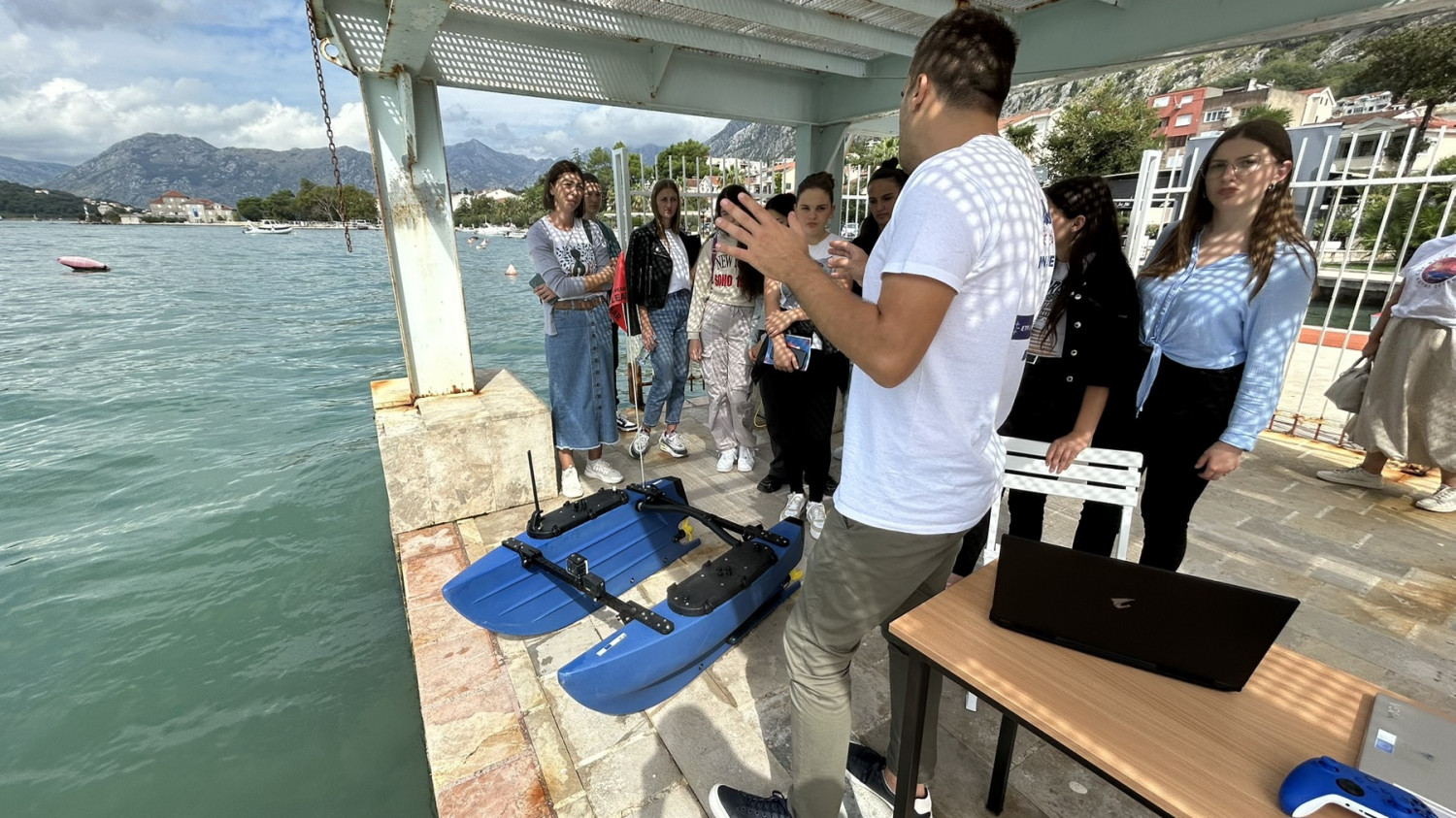
Imagine being able to check the sea the way we check the weather! Not occasionally, but every day, in real time. That’s the simple idea behind MONUSEN (Montenegrin Centre for Underwater Sensor Networks), an EU-supported project helping Montenegro build the skills and technology to monitor the underwater world more safely, faster, and more accurately.
For the European Union, excellence in science and the exchange of knowledge are of paramount importance. This is why, through a range of programmes and projects, it actively promotes cooperation among Member States and candidate countries. In this context, the MONUSEN project (MONtenegrin Centre for Underwater SENsor Networks), dedicated to underwater sensor networks, has recently been supported through the Horizon Europe Twinning programme. The project was implemented by the University of Montenegro in cooperation with the Faculty of Electrical Engineering and Computing of the University of Zagreb, Newcastle University, and the Italian National Research Council, all of which are leading European research institutions in the fields of underwater communications and marine robotics.
“MONUSEN is a project focused on research into underwater sensor networks and advanced marine monitoring. Its main objective was to develop knowledge, methodologies and practical competences for modern underwater monitoring and to embed them sustainably into our work through training, joint research activities and the adoption of contemporary research practices”, says Igor Radusinović from the Faculty of Electrical Engineering at the University of Montenegro.
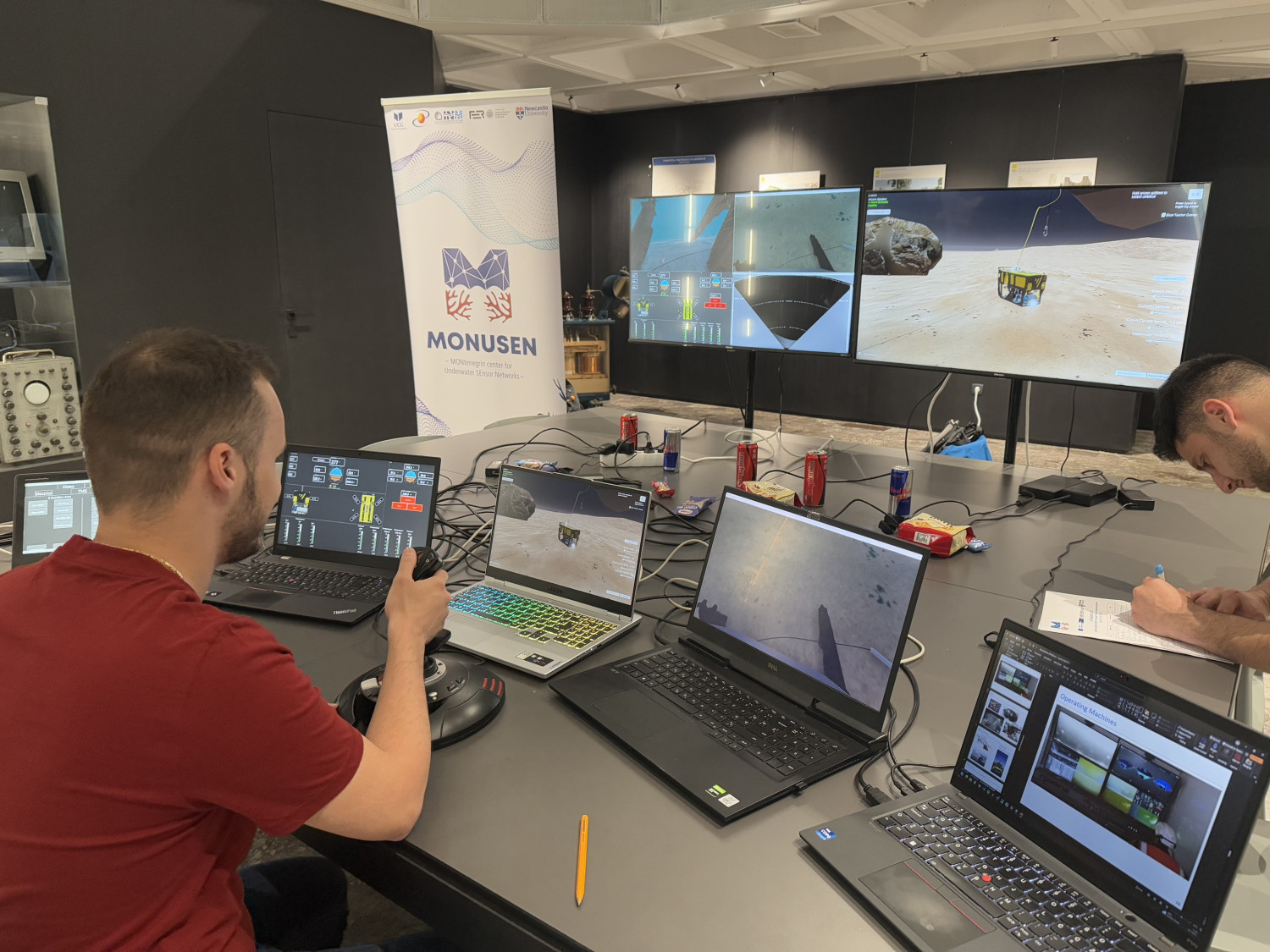
Underwater sensor networks (USNs) are important because they enable the collection of oceanographic data, pollution monitoring, exploration of natural underwater resources, disaster prevention, assisted navigation and the application of tactical surveillance. Their use is expanding globally, as they allow for long-term monitoring of marine environments without the continuous presence of personnel in the field, while data are delivered regularly, enabling rapid responses and informed decision-making.
Radusinović explains that this work is relevant to all those engaged in technologies serving marine environments – from environmental protection and biodiversity conservation, through the development of the blue economy, to maritime safety and security.
“The sea is vast, dynamic and often difficult to access, and traditional monitoring based on occasional measurements and short-term field surveys is increasingly insufficient for tracking the impacts of climate change, the pressures of tourism and maritime traffic, the needs of aquaculture, as well as for the timely detection of incidents, unusual activities and sudden environmental changes. The capacities developed through this project remain a lasting asset for students and early-career researchers, for institutions that rely on data in coastal and marine resource management, and for industry seeking new services and solutions within the blue economy.”, Radusinović explains.
Nikola Mišković from the FEEC in Zagreb says that the project is exceptionally important because it aims to reduce disparities in research excellence between the University of Montenegro (UoM) and leading European institutions in the field of underwater sensor networks.
“It has enabled students and researchers at the UoM to work with state-of-the-art equipment and leading experts, while the greatest benefits are realised by end users in the fields of marine biology, archaeology, security and environmental protection, as the project develops tools for more effective monitoring of the Adriatic Sea. We became involved because of the scientific challenges associated with coordinated navigation and communication constraints underwater, as well as for reasons of strategic networking”, Mišković says, emphasising that this cooperation builds on a long-standing partnership.
Radusinović and Mišković, who worked on the project alongside Jeff Neasham from Newcastle University and Massimo Caccia from the National Research Council of Italy in Genoa, agree that the project activities would have been impossible to carry out without EU support.
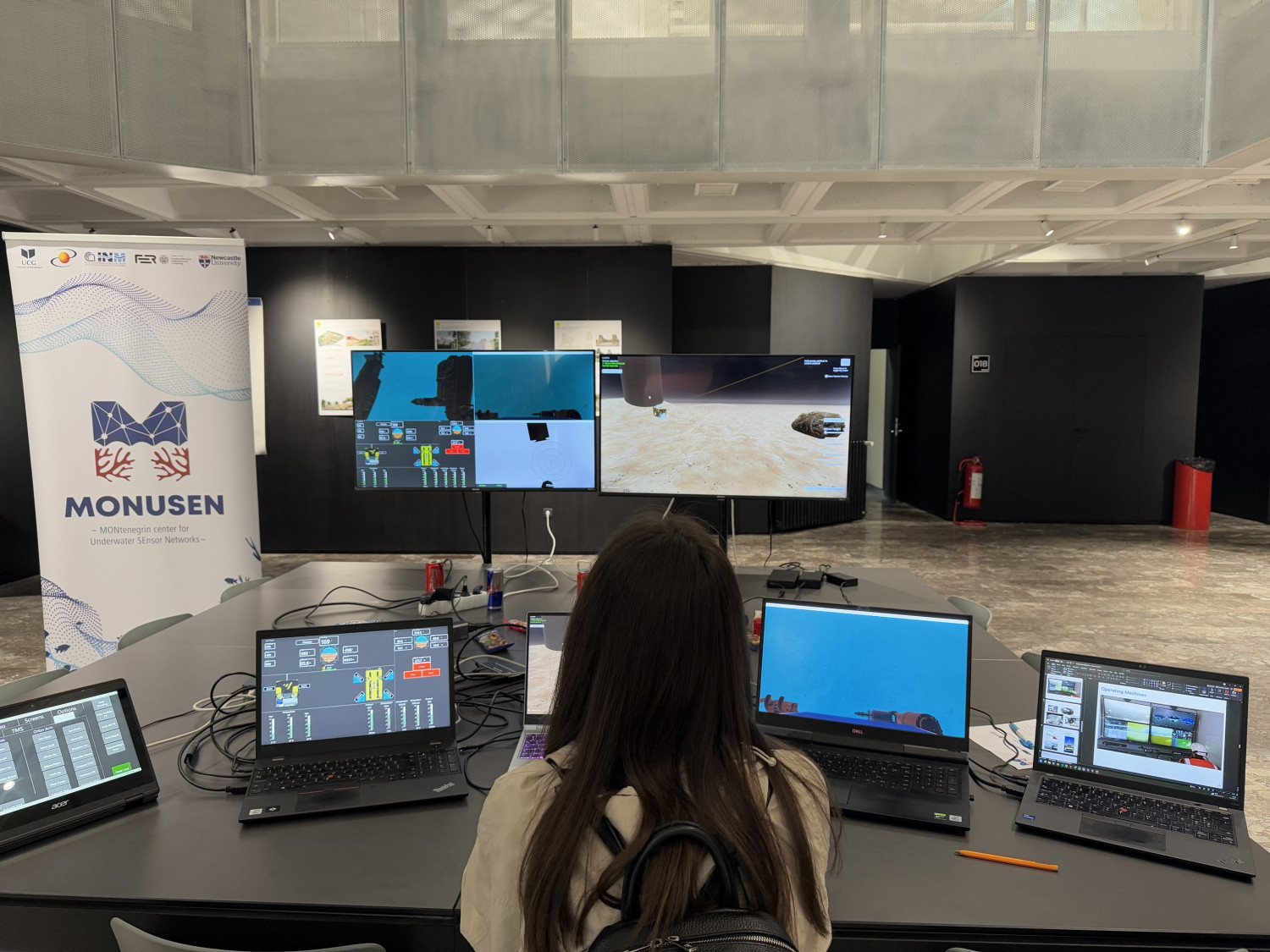
“Participation in the Horizon Europe programme has given us credibility and placed us on the map of European researchers. Without the Twinning programme, we might have carried out a small-scale experiment, but we would not have been able to build the sustainable research capacity that we now possess”, Radusinović says.
Mišković explains that the Twinning programme is designed to connect expertise from leading EU institutions with the potential of developing countries.
“Collaboration with colleagues from Montenegro, Italy and the United Kingdom enables the integration of knowledge from robotics, telecommunications and artificial intelligence under the specific conditions of the Adriatic Sea. This requires substantial funding for mobility and joint experimental campaigns, which national funding schemes rarely support. Without EU funding, it would be impossible to bring together such a consortium of top-level experts working jointly to reduce the scientific gap within Europe”, Mišković concludes.
Cooperation among the partners continues through a range of activities, some of which will have a commercial dimension.
“We now have a well-coordinated team, tangible results and experience gained through training, exchanges and joint experiments. This means that we are entering new project applications far better prepared and with a clearer vision of what we want to develop”, Radusinović says.
Horizon Europe Twinning is a programme aimed at strengthening scientific excellence and institutional networking by linking organisations from less developed countries with at least two leading European research centres. Its primary focus is development of skills through cooperation. It forms part of the Horizon Europe ‘Widening Excellence’ framework and has a budget of €264.5 million. The programme’s objectives include enhancing research capacities, facilitating knowledge exchange and increasing participation in EU-funded projects through institutional partnerships and stronger networking activities.
Underwater sensor networks (USNs) are important because they enable the collection of oceanographic data, pollution monitoring, exploration of natural underwater resources, disaster prevention, assisted navigation and the application of tactical surveillance. Their use is expanding globally, as they allow for long-term monitoring of marine environments without the continuous presence of personnel in the field, while data are delivered regularly, enabling rapid responses and informed decision-making.
Radusinović explains that this work is relevant to all those engaged in technologies serving marine environments – from environmental protection and biodiversity conservation, through the development of the blue economy, to maritime safety and security.
“The sea is vast, dynamic and often difficult to access, and traditional monitoring based on occasional measurements and short-term field surveys is increasingly insufficient for tracking the impacts of climate change, the pressures of tourism and maritime traffic, the needs of aquaculture, as well as for the timely detection of incidents, unusual activities and sudden environmental changes. The capacities developed through this project remain a lasting asset for students and early-career researchers, for institutions that rely on data in coastal and marine resource management, and for industry seeking new services and solutions within the blue economy.”, Radusinović explains.
Nikola Mišković from the FEEC in Zagreb says that the project is exceptionally important because it aims to reduce disparities in research excellence between the University of Montenegro (UoM) and leading European institutions in the field of underwater sensor networks.
“It has enabled students and researchers at the UoM to work with state-of-the-art equipment and leading experts, while the greatest benefits are realised by end users in the fields of marine biology, archaeology, security and environmental protection, as the project develops tools for more effective monitoring of the Adriatic Sea. We became involved because of the scientific challenges associated with coordinated navigation and communication constraints underwater, as well as for reasons of strategic networking”, Mišković says, emphasising that this cooperation builds on a long-standing partnership.
Radusinović and Mišković, who worked on the project alongside Jeff Neasham from Newcastle University and Massimo Caccia from the National Research Council of Italy in Genoa, agree that the project activities would have been impossible to carry out without EU support.
“Participation in the Horizon Europe programme has given us credibility and placed us on the map of European researchers. Without the Twinning programme, we might have carried out a small-scale experiment, but we would not have been able to build the sustainable research capacity that we now possess”, Radusinović says.
Mišković explains that the Twinning programme is designed to connect expertise from leading EU institutions with the potential of developing countries.
“Collaboration with colleagues from Montenegro, Italy and the United Kingdom enables the integration of knowledge from robotics, telecommunications and artificial intelligence under the specific conditions of the Adriatic Sea. This requires substantial funding for mobility and joint experimental campaigns, which national funding schemes rarely support. Without EU funding, it would be impossible to bring together such a consortium of top-level experts working jointly to reduce the scientific gap within Europe”, Mišković concludes.
Cooperation among the partners continues through a range of activities, some of which will have a commercial dimension.
“We now have a well-coordinated team, tangible results and experience gained through training, exchanges and joint experiments. This means that we are entering new project applications far better prepared and with a clearer vision of what we want to develop”, Radusinović says.
Horizon Europe Twinning is a programme aimed at strengthening scientific excellence and institutional networking by linking organisations from less developed countries with at least two leading European research centres. Its primary focus is development of skills through cooperation. It forms part of the Horizon Europe ‘Widening Excellence’ framework and has a budget of €264.5 million. The programme’s objectives include enhancing research capacities, facilitating knowledge exchange and increasing participation in EU-funded projects through institutional partnerships and stronger networking activities.
Please wait while your video is being uploaded...
Don't close this window!