The path towards a water resilient Europe


The path towards a water resilient Europe
By Megi Marku
Europe is the fastest warming continent and for many Europeans climate change is felt through water. Yet the water sector remains under-managed and under-governed, while water itself continues to be the most undervalued and under-priced resource.
Last year, I led the production of the Youth Position Paper on Water Resilience Strategy along with WYPW and EYPW, to deliver what young people want to see on the pathway toward a water resilient Europe. Since then, the Commission has indicated an interest in engaging young people in the strategy’s implementation, and we look forward to working together to shape how this can evolve into meaningful action.
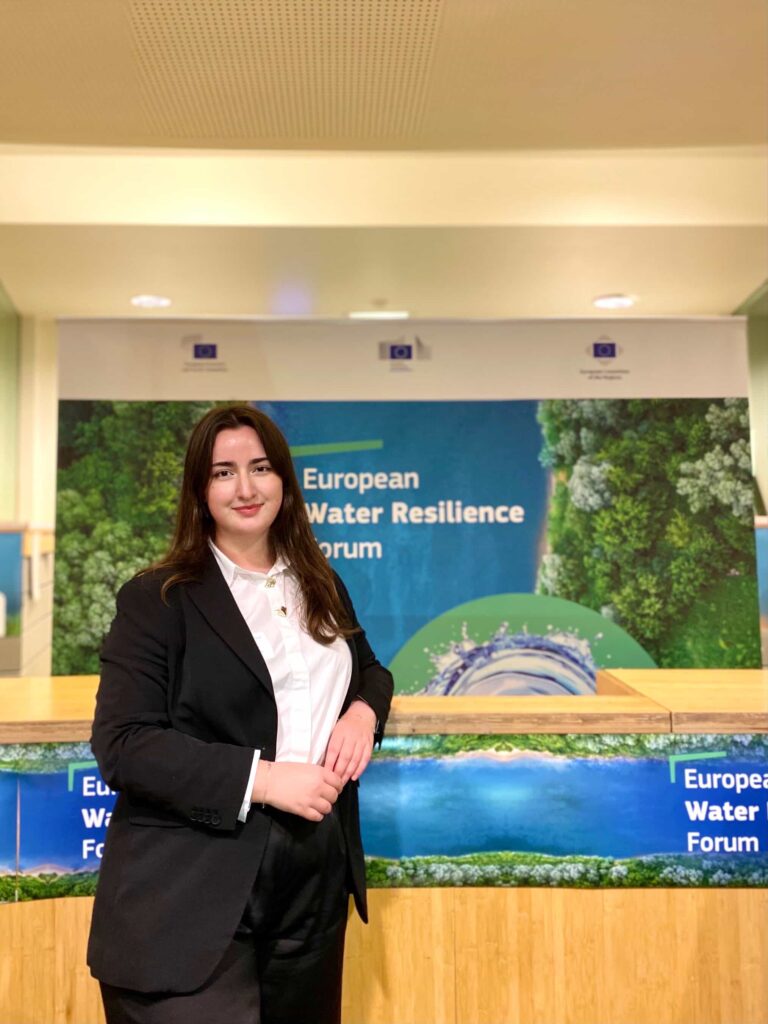
Following the adoption of the European Water Resilience Strategy, I was invited by DG Environment to participate in the first ever Water Resilience Forum, where policymakers, scientists, industry leaders, and civil society gathered to share solutions and explore new possibilities through an inclusive dialogue addressing urban water challenges, digital transformation, and upskilling initiatives – all essential for building a water-secure Europe by 2050.
The three pillars of strategy
But what is the goal of the European Water Resilience Strategy? This strategy is built on three main pillars:
- Restoring and protecting the water cycle: Focused on retaining more water in soils, forests, and wetlands while tackling pollution to ensure water quality.
- Building a water smart economy: For an economy that grows sustainable and its water efficient, by reducing demand, promoting reuse, and increasing efficiency across sectors.
- Ensuring clean affordable water for all: While recognizing water as a human right, raising awareness, supporting policies, and promoting resilience worldwide.
It includes over 30 actions, mostly aimed at governments, but with implications for sectors including agriculture, energy, and industry. You can check out the full strategy here.
Partnerships and cooperation have taken a central role in the implementation of the EWRS, and it also reflected as the main theme and priority of this forum. It is indisputable that we need a multi-stakeholder approach to make sure we strengthen Europe’s water security agenda, that includes an imperative need to bring young people at the table to take part in today’s decisions that will shape their near future. The Global Commission on the Economics of Water has demonstrated that current water mismanagement will shrink global GDP by up to 15% by 2050 – a challenge my generation will inherit, and one we must confront together.
Bridging the skills gap
Among the six solution-oriented parallel sessions I followed the discussions focused on Upskilling (specifically on Water Academy) and Water Finance, two topics that closely resonate with me, especially as a young professional.
The European Water Academy is a promising initiative aimed at strengthening the current work force through hands-on training and upskilling with further potential to engage young professionals more directly. A vision in bridging the generational skill gap is required, knowing that this sector is often described as an ‘aging’ one makes it even more fundamental to invest in the young professionals who are going to manage the very systems we are working on today.
We can expect a more modern and innovative sector if we provide access to knowledge and cutting-edge solutions for young professionals, while at the same time supporting them as they build and scale their ideas. Having young people engaged, involved and leading ensures sustainability, and this is how we can strengthen Europes long-term water resilience.
A new lens for finance
During the forum, it was highlighted that we need to “look at the economy though a water lens, not look at water though an economic lens”. However, barriers such as unclear financial metrics for water risks, low bankability, fragmented projects and regulatory uncertainty are making it harder to secure investments for water projects.
It is true that there has to be a fundamental shift in how water sector policies are managed and how water sector regulatory practices are adopted. This is why we need new and long term approaches to give private sector the security and confidence in coming in to invest in these projects. If we are serious about closing the yearly $1 trillion investment gap needed to meet the SDG6 targets by 2030, we must rethink how we evaluate water investments. Water projects approved today will determine water security for the next 50 to 100 years, yet we evaluate them on 10-15 year return. With young people on board, we can bring a new lens of intergenerational justice within these financial frameworks.
The Water Resilience Forum created the space to establish a unified vision for water resilience in Europe by 2050, it showed that if we act boldly now, we can ensure that future generations will inherit security instead of scarcity. 2025 proved that water has always been about resilience; 2026 must show that resilience means action. Together with you, my generation is ready to lead that shift.