Follow Me Club: EU for Clean Air


Follow Me Club: EU for Clean Air
By Nikola Mihail Angelovski
It's that time of the year, and not just a cozy winter but polluted air as well!
Hi, I'm Nikola, a Young European Ambassador from Skopje. Recently, I visited the “EU for Clean Air” project alongside Damjan and Jana, to see how they're helping tackle pollution in our country. What I discovered is that the EU isn't just talking about supporting our region – they're investing real money, real effort, and real solutions into making our cities healthier. So come check out what I found and why I think this matters for all of us.
Understanding the problem: Why air quality matters
Before we take you through our recent visit to the EU for Clean Air project, let's pause and address something fundamental that many people in our region experience but don't always fully understand: air pollution and why it matters so deeply.
Every winter, the reality becomes impossible to ignore in cities across North Macedonia. When temperatures drop, heating systems turn on, and traffic increases, the air becomes visibly thick with pollution. Skopje, along with Bitola, Kumanovo, and Tetovo, regularly appears on lists of the world's most polluted cities. But behind those rankings is a health crisis that affects real people, particularly the most vulnerable.
You might hear technical terms like PM2.5 and PM10. Here's what they actually mean: PM stands for particulate matter, referring to tiny particles suspended in the air that we breathe directly into our lungs. PM2.5 are particles so small that they measure just 2.5 micrometers in diameter. To put that in perspective, a human hair is about 70 micrometers wide. These microscopic particles penetrate deep into our respiratory system and can even enter our bloodstream. PM10 particles are slightly larger but still incredibly fine. Both are harmful to human health, and North Macedonia's major cities regularly exceed safe exposure limits for 100 or more days per year.
Beyond health, air pollution affects our quality of life. Visibility decreases. Public spaces become less inviting. The simple act of breathing becomes something we notice, something that requires caution rather than being natural and unconscious. For students, workers, parents, and everyone navigating our cities daily, this invisible threat shapes our experience of home.
This is the context in which the EU for Clean Air project was born, and understanding this background helps explain why what we witnessed during our visit felt so significant.
The roads we travel: Green transport revolution
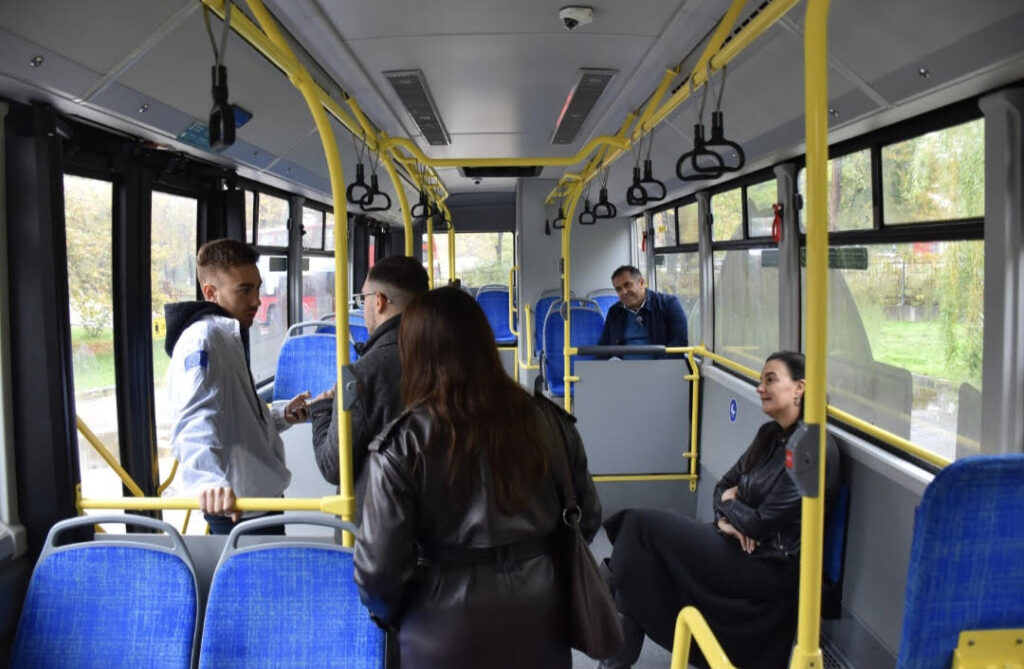
Our first stop revealed something that made an immediate impression: electric buses rolling through Skopje's streets. When the director of JSP walked us through what these vehicles mean for our public transport network, the picture became crystal clear. These aren't just buses that look good – they're a fundamental shift in how we move around our city.
With a passenger capacity of 96 and equipped with the latest EURO 6 standard technologies, these buses cut emissions dramatically. We're talking about just 9 grams of CO2 per passenger per kilometer and incredibly low nitrogen oxide emissions. The director emphasized how this isn't merely about environmental metrics. It's about cleaner air that residents actually breathe, reduced noise in our neighborhoods, and a transport system that respects both people and the planet.
What struck us most was learning that this transformation isn't just cosmetic. It represents a genuine commitment to building a greener, healthier Skopje – one journey at a time.
Planting hope: 6,000 trees and counting
Then we met the scouts involved in the urban greening component. Their energy was contagious. While we discussed policy and infrastructure, they shared something more tangible: they've been part of planting 6,000 trees across Skopje, Bitola, Tetovo, and Kumanovo. Six thousand.
These trees aren't decorative. Each one is an investment in absorbing carbon dioxide, reducing particulate matter, and transforming our public spaces into places where people want to spend time. The scouts spoke with genuine pride about their contribution to this green initiative. They understood something important that sometimes gets lost in bureaucratic language – that planting trees today means breathing cleaner air tomorrow, and creating spaces for community and recreation for generations to come.
Smart heating for a smarter future
Our final stop was particularly moving. At kindergarten 25 Maj in Skopje, we met the engineers implementing an innovative heating system in a building that had stood for fifty years. Here's what makes this remarkable: they're making a building built in the mid-1970s energy efficient through modern solutions. This isn't about demolition and rebuild – it's about intelligence, sustainability, and respect for what already exists.
The heating system they are installing is part of a larger effort across 70 public buildings in our four cities. When these upgrades are complete, they'll reduce particulate matter by up to 98 percent. They'll cut sulfur dioxide emissions by 99 percent. These numbers represent something tangible – they represent cleaner air flowing through healthcare facilities and schools, spaces where vulnerable people spend their days.
The engineers showed us the technical details, but most importantly, they showed us the vision. This isn't about expensive, flashy solutions that work for a year then fade. It is about sustainable, intelligent adaptation that serves communities for decades.
What this means for us
As Young European Ambassadors, we often talk about how EU support benefits the Western Balkans. But this visit transformed those conversations from abstract to concrete. The EU for Clean Air project isn't just policy. It's buses carrying neighbors to work. It's thousands of trees growing in public spaces. It's kindergartens where children breathe cleaner air while they learn and play.
This €10 million initiative, funded by the European Union and implemented through the Ministry of Environment and Physical Planning, represents something crucial about the European integration process and the Western Balkans’ place within it. It demonstrates that Europe's commitment to supporting our region isn't just rhetorical. It's measured in emissions reduced, in trees planted, in buildings transformed.
We came away from this visit with a clear understanding: the challenges facing our cities are real, but so are the solutions. And those solutions are already here, already working, already changing Skopje into the healthier, greener city we all deserve.
To everyone reading this in North Macedonia and across the Western Balkans: these projects exist for us. They exist because young people, communities, and committed institutions believe that we deserve cleaner air, better transport, and a more sustainable future. That's not just an EU investment. That's a promise being kept, one bus, one tree, one building at a time.