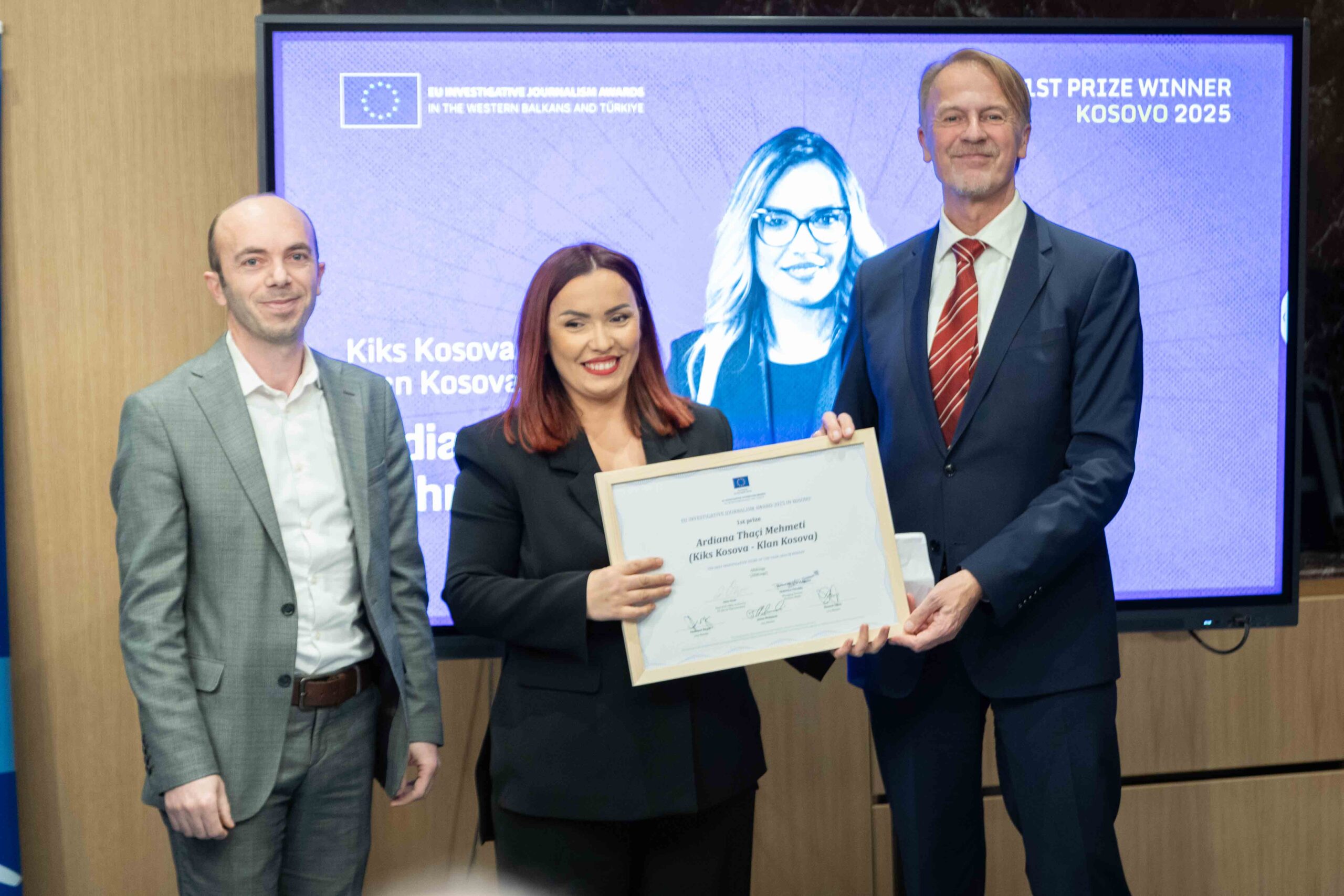
Interview with Ardiana Thaçi Mehmeti
Over the past few weeks, the Western Balkan countries have been celebrating investigative journalism. Professional juries across Serbia, Bosnia and Herzegovina, Montenegro, Albania, North Macedonia, and Kosovo have gathered to evaluate some of the most compelling investigative journalism pieces.
We spoke to all first-prize winners across the region, and will publish the interviews with them in series. Through this series that we have titled “EU Celebrates Investigative Journalism in the Western Balkans” we want to celebrate these exemplary journalists and get to know more about their investigation practices, the urgency of addressing these issues in their country as well as their reflections on the position of investigative journalism in their country and in the region at large.
Kosovo was the latest to announce the winners. Jury members Anamari Repić, Jeton Mehmeti and Kosovë Gjoci awarded the first prize to Ardiana Thaçi Mehmeti for her series “Albkings” presented at Kiks Kosova. Thaçi Mehmeti refers to this investigation as a combination of professional documentation, personal resilience, and public exposure. Albkings looks into digital safety of women and uncovers an organized online harassment campaign mainly against women journalists.
Ardiana Thaçi Mehmeti is an investigative journalist, author, and television producer. With over 20 years of experience in the media sector in Kosovo, Thaçi Mehmeti has become one of the strongest voices in critical and investigative journalism, with work that has directly influenced important social, political, and human rights issues.
Thaçi Mehmeti began her journalism career in 2005 at Kohavision, where she stood out for her analytical style, bold approach, and in-depth reporting. For nearly fifteen years, she worked as a journalist and author, also contributing to the political show Rubikon with Adriatik Kelmendi and the documentary Cosmo. Her continuous work led her to complex investigations, often in areas that touched corruption, rights violations, and phenomena of social marginalization.
Thaçi Mehmeti is the co-founder of Kiks Kosova, a media organization that produces investigative programs and documentaries with wide public impact. Since 2020, she has been the author, journalist, and producer of the investigative show Kiks Kosova and the documentary Alibi, broadcast on Klan Kosova five times a week. Through this work, she has built a strong reputation as a journalist who challenges taboos, opens sensitive topics, and gives voice to silent or unheard individuals and communities..
Her contribution has been widely recognised with national and international awards. She is a two-time First Prize winner for Reporting on Poverty from UNDP & AGK (2009, 2016), recipient of the Human Rights Reporting Award from BIRN, ACDC, and the Office of the Ombudsperson (2018), as well as third place in the EU Investigative Reporting Awards for the Western Balkans and Turkey (2019).
She has also received the UNDP Award for Journalism Against Corruption (2019), the “Rexhai Surroi” Award for written journalism (2019), and recognition for reporting during the COVID-19 pandemic from KosovaLive (2020). In 2022, she was honored with the First Prize for Best Reporting on Inter-Community Cohabitation for the documentary The Silence that Killed, awarded by Peaceful Change Initiative and supported by the United Kingdom.
In 2024, Ardiana Thaçi Mehmeti was named Kosovo’s Journalist of the Year by the Association of Journalists of Kosovo.
Throughout her career, Thaçi Mehmeti has worked in high-pressure environments, dealing with sensitive topics and often facing attacks, pressure, and personal risk. Yet she has remained committed to her mission of producing quality, independent, and verified journalism, demonstrating that investigative journalism is a crucial pillar of democracy and public transparency in Kosovo.
She continues to be active in producing new investigations, advocating for women’s rights, and strengthening the standards of independent journalism. Today she is considered one of the most trusted and influential journalists in the country.

WeBalkans: The safety of women in Kosovo remains scarce. There is even more limited knowledge and public discourse produced about the digital/online safety of women. What were the risks you undertook in your process? A short overview of the piece and your investigative process is what we are looking for with this question.
Ardiana Thaçi Mehmeti: The investigation process for the “AlbKings” series began as a standard journalistic inquiry, but very quickly turned into a personal and extremely dangerous situation. Initially, as a newsroom, we had reported on a large group on Telegram that was distributing illegal material — including private data and images of girls and women, even minors. But the investigation took an unexpected turn when my phone number was published in the same group with around 100,000 men. From that moment, the case was no longer just a work topic; it became a direct form of pressure and violence against me.
The first step in my investigative process was going public and documenting every contact. While at work, I recorded every call, message, audio, and video in order to have evidence that would later be necessary for the police and prosecution.
At home, to cope with the psychological pressure, I sought the support of my husband, who often responded to anonymous calls — because the callers would immediately hang up when they heard a male voice. This also became evidence of how these networks functioned.
The main risks during the process were not technical or professional, but emotional and personal. Continuous harassment, calls day and night, and fear of unknown numbers created extraordinary psychological pressure. The danger became even greater when the groups began collecting information about my family, turning the investigation into a battle that affected people who had no connection to my profession. This was the most painful moment and the strongest indication of how deep the problem was.
On the methodological side, parallel to documenting everything, I reported the case to the police immediately. The institutional response was swift and professional, offering protection and treating the case with high priority. To protect myself and others, I made the decision to make everything public. Transparency became my strongest weapon and a call for all women experiencing similar forms of violence not to remain silent.
The publication of the material caused wide reactions: many women reported similar cases, institutions opened investigations, some of the networks were shut down, and perpetrators involved were arrested.
This process clearly showed not only the scale of the phenomenon, but also how fragile the digital safety of women in Kosovo is — and how necessary journalism is that documents and exposes this violence.
The “AlbKings” investigation was a combination of professional documentation, personal resilience, and public exposure, in a landscape where risk was not theoretical but real, constant, and directly targeted at me and my family.

WeBalkans: What are your thoughts on the position of journalism at large in the region today, and especially of investigative journalism?
Ardiana Thaçi Mehmeti: In regions like the Western Balkans, it seems like the need for independent investigative journalism is even more urgent, whereas pressure towards journalists and investigative journalism is at the same time higher and ever-more present. What are your thoughts on this?
The position of journalism in the region, especially investigative journalism, is complex and challenging. In the Western Balkans, the need for independent investigative journalism is more urgent than ever, because phenomena of violence, corruption, cybercrime, and public manipulation are becoming increasingly sophisticated. However, the pressure on journalists is equally high, constant, and often systemic.
My experience with “AlbKings” confirmed this reality. On the one hand, the institutional system responded strongly and seriously. Arrests, the shutdown of groups, and international cooperation — including with the FBI — proved that investigative journalism can trigger concrete action and bring about real change.
But on the other hand, the public reaction and the attacks against me revealed a deeper cultural problem in the region: the Balkan mentality where women are often blamed, even when they are victims. In our patriarchal societies, the victim frequently faces accusation, shaming, or doubt, while the perpetrator is protected by a kind of “male solidarity” on social networks or in anonymous groups. This deeply rooted prejudice makes the work of female journalists even more difficult — especially those dealing with sensitive topics and who challenge this mentality.
Nevertheless, I believe investigative journalism is more essential than ever. It creates transparency, enforces public accountability, and is often the only light that penetrates spaces where power is abused, where women are harmed, and where public safety is endangered. For this reason, despite the risks and pressures, I remain convinced that investigative journalism is one of the strongest tools our society has in the fight against injustice, violence, and mentalities that continue to blame the victim instead of the perpetrator.
WeBalkans: The safety of women in Kosovo remains scarce. There is even more limited knowledge and public discourse produced about the digital/online safety of women. What were the risks you undertook in your process? A short overview of the piece and your investigative process is what we are looking for with this question.
Ardiana Thaçi Mehmeti: The investigation process for the “AlbKings” series began as a standard journalistic inquiry, but very quickly turned into a personal and extremely dangerous situation. Initially, as a newsroom, we had reported on a large group on Telegram that was distributing illegal material — including private data and images of girls and women, even minors. But the investigation took an unexpected turn when my phone number was published in the same group with around 100,000 men. From that moment, the case was no longer just a work topic; it became a direct form of pressure and violence against me.
The first step in my investigative process was going public and documenting every contact. While at work, I recorded every call, message, audio, and video in order to have evidence that would later be necessary for the police and prosecution.
At home, to cope with the psychological pressure, I sought the support of my husband, who often responded to anonymous calls — because the callers would immediately hang up when they heard a male voice. This also became evidence of how these networks functioned.
The main risks during the process were not technical or professional, but emotional and personal. Continuous harassment, calls day and night, and fear of unknown numbers created extraordinary psychological pressure. The danger became even greater when the groups began collecting information about my family, turning the investigation into a battle that affected people who had no connection to my profession. This was the most painful moment and the strongest indication of how deep the problem was.
On the methodological side, parallel to documenting everything, I reported the case to the police immediately. The institutional response was swift and professional, offering protection and treating the case with high priority. To protect myself and others, I made the decision to make everything public. Transparency became my strongest weapon and a call for all women experiencing similar forms of violence not to remain silent.
The publication of the material caused wide reactions: many women reported similar cases, institutions opened investigations, some of the networks were shut down, and perpetrators involved were arrested.
This process clearly showed not only the scale of the phenomenon, but also how fragile the digital safety of women in Kosovo is — and how necessary journalism is that documents and exposes this violence.
The “AlbKings” investigation was a combination of professional documentation, personal resilience, and public exposure, in a landscape where risk was not theoretical but real, constant, and directly targeted at me and my family.
WeBalkans: What are your thoughts on the position of journalism at large in the region today, and especially of investigative journalism?
Ardiana Thaçi Mehmeti: In regions like the Western Balkans, it seems like the need for independent investigative journalism is even more urgent, whereas pressure towards journalists and investigative journalism is at the same time higher and ever-more present. What are your thoughts on this?
The position of journalism in the region, especially investigative journalism, is complex and challenging. In the Western Balkans, the need for independent investigative journalism is more urgent than ever, because phenomena of violence, corruption, cybercrime, and public manipulation are becoming increasingly sophisticated. However, the pressure on journalists is equally high, constant, and often systemic.
My experience with “AlbKings” confirmed this reality. On the one hand, the institutional system responded strongly and seriously. Arrests, the shutdown of groups, and international cooperation — including with the FBI — proved that investigative journalism can trigger concrete action and bring about real change.
But on the other hand, the public reaction and the attacks against me revealed a deeper cultural problem in the region: the Balkan mentality where women are often blamed, even when they are victims. In our patriarchal societies, the victim frequently faces accusation, shaming, or doubt, while the perpetrator is protected by a kind of “male solidarity” on social networks or in anonymous groups. This deeply rooted prejudice makes the work of female journalists even more difficult — especially those dealing with sensitive topics and who challenge this mentality.
Nevertheless, I believe investigative journalism is more essential than ever. It creates transparency, enforces public accountability, and is often the only light that penetrates spaces where power is abused, where women are harmed, and where public safety is endangered. For this reason, despite the risks and pressures, I remain convinced that investigative journalism is one of the strongest tools our society has in the fight against injustice, violence, and mentalities that continue to blame the victim instead of the perpetrator.
Please wait while your video is being uploaded...
Don't close this window!