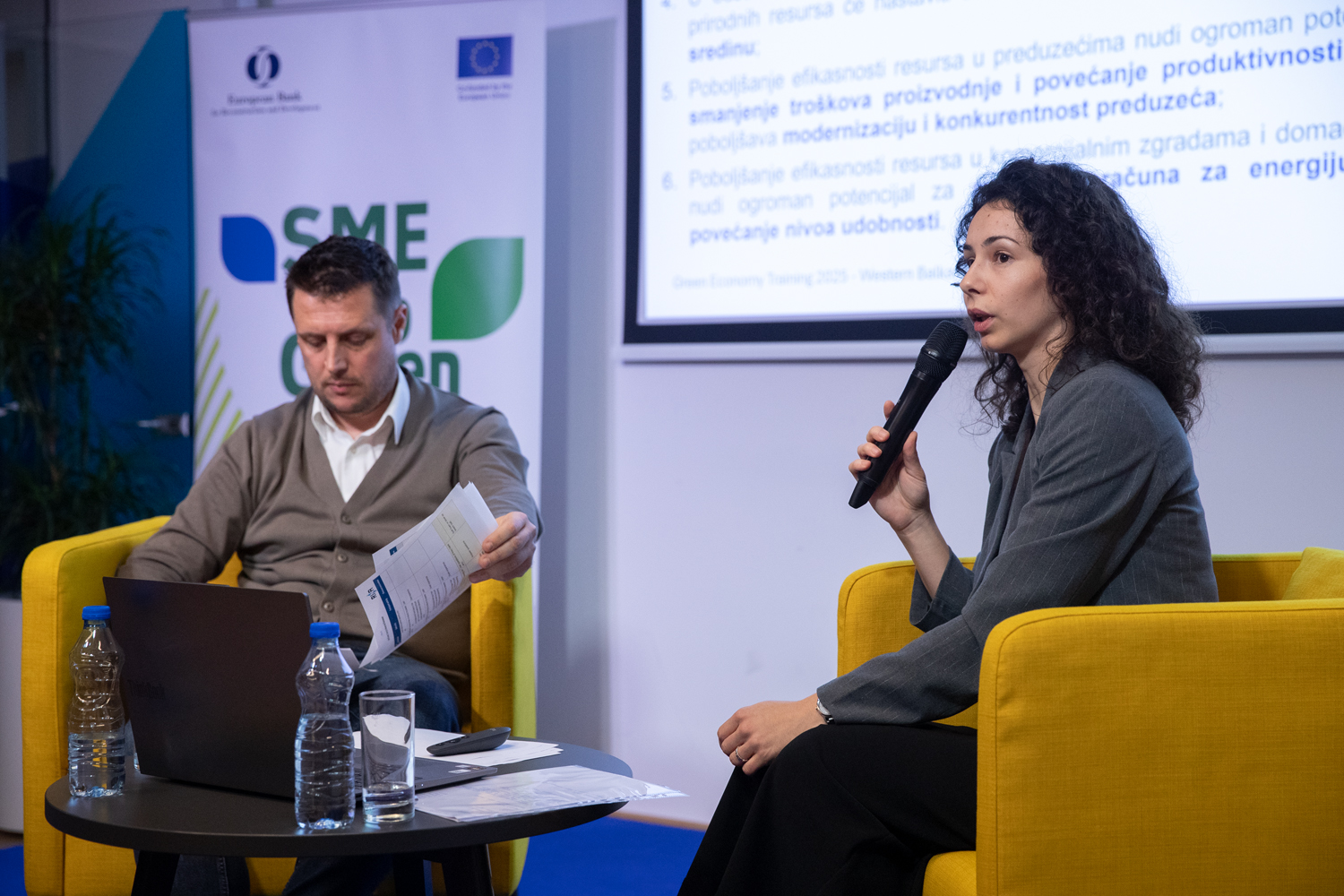
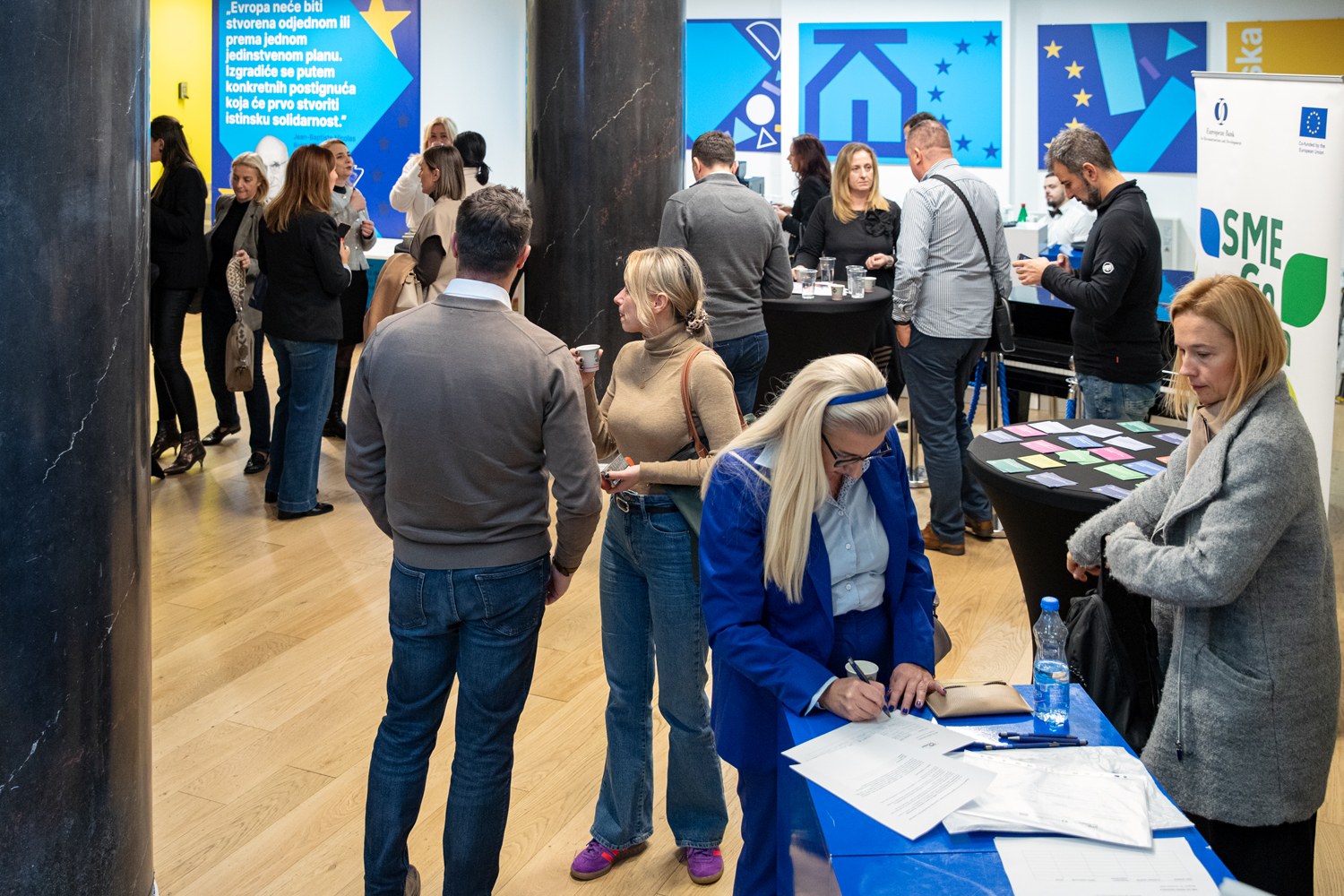
The European Union is strongly committed to expanding the use of green energy and, in this context, supports numerous programmes in candidate countries for EU membership. One such programme is SME Go Green, implemented by the European Bank for Reconstruction and Development (EBRD) with EU financing. As part of the programme, a workshop for women entrepreneurs was held in Serbia. The aim was to provide participants with practical knowledge on green investments and access to finance that enables the sustainable development of women-led small and medium-sized enterprises. According to the organisers, each of the approximately 40 participants left the workshop with clear information on how to apply for a project, which documentation to prepare, and where to seek support.
“SME Go Green supports small and medium-sized enterprises across the Western Balkans in adopting green technologies and sustainable practices, helping them to become more competitive in both local and EU markets. The focus is on reducing energy costs and emissions, aligning with EU and international standards, while also providing support to agribusinesses and enterprises owned or led by women. We have allocated around EUR 400 million for financing, while the EU has provided grants covering 10–15% of the loan amount. Our objective is for at least 33% of the loans disbursed to go to agribusinesses and at least 25% to women-led enterprises”, explains Arita Hasani, Principal Banker and Operations Leader for SME Go Green in the Western Balkans at the EBRD.
Local SME Go Green programme experts Maja Krstović and Vladimir Đorđević explain that the structure of the workshop was designed on the basis of a survey conducted among women owners of small businesses. Discussions focused on the reality of climate change and its impact on sectors managed by women, ranging from agriculture and the food industry to manufacturing activities. Participants analysed how extreme weather events, droughts and floods directly threaten their supply chains, and why climate resilience is just as important as profitability. Practical technological solutions were presented, including photovoltaic power plants, solar thermal collectors, geothermal heat pumps, and energy-from-waste systems such as biogas and biomass. Financial figures, investment payback periods and examples from the region were also shared. The workshop additionally provided an opportunity to discuss resource efficiency and the circular economy in the day-to-day operations of small and medium-sized enterprises. Through case studies, participants learned what it means to reduce water consumption by 40%, cut electricity use by one third, or convert waste into raw materials — and how this has already been achieved in Serbia and neighbouring countries.
One of the participants was Aleksandra Šakotić, Chief Financial Officer of Meter&Control d.o.o. She emphasised the importance of highlighting the economic benefits of such investments, including grant support and more favourable financing conditions, as financial sustainability and return on investment are often key factors in investment decision-making.
“Operating in line with the principles of sustainable development is no longer a matter of choice, but an imperative for business sustainability and for the broader impact that business decisions have on society as a whole. I see it as an opportunity for long-term business improvement rather than an additional cost or obligation, as the benefits are multiple: reduced negative environmental impact and more responsible resource management”, says Šakotić, stressing that sustainable business practices can generate both environmental and economic value. She notes that the green transition requires a change in mindset and a consistent, systematic approach, and that the greatest internal challenge lies in understanding and accepting the concept itself.

“Sustainability principles must be fully integrated into all business processes, but it is crucial that all employees understand why these principles matter and how they relate to their everyday work. This requires a comprehensive view of all aspects of business operations, from production processes and human resources management to decision-making and investment planning. When the green transition is not perceived as an imposed obligation, but as a shared goal and part of a company’s culture, the process becomes much easier and more sustainable in the long term”, Šakotić explains adding that sustainable business is a broad and comprehensive concept which, with the right approach, can be successfully applied across almost all segments of business operations.
The SME Go Green workshop: Empowering Women Entrepreneurs in the Green Transition was organised as part of the European Green Diplomacy Week 2025 held from 14 to 25 November, with a focus on water protection and sustainable development. The initiative is part of a global European Union campaign that promotes cooperation in tackling climate change and inspires climate action. The EBRD has announced that similar workshops under the SME Go Green Programme will be held in Bosnia and Herzegovina, Montenegro and Kosovo where the programme is also active.
Local SME Go Green programme experts Maja Krstović and Vladimir Đorđević explain that the structure of the workshop was designed on the basis of a survey conducted among women owners of small businesses. Discussions focused on the reality of climate change and its impact on sectors managed by women, ranging from agriculture and the food industry to manufacturing activities. Participants analysed how extreme weather events, droughts and floods directly threaten their supply chains, and why climate resilience is just as important as profitability. Practical technological solutions were presented, including photovoltaic power plants, solar thermal collectors, geothermal heat pumps, and energy-from-waste systems such as biogas and biomass. Financial figures, investment payback periods and examples from the region were also shared. The workshop additionally provided an opportunity to discuss resource efficiency and the circular economy in the day-to-day operations of small and medium-sized enterprises. Through case studies, participants learned what it means to reduce water consumption by 40%, cut electricity use by one third, or convert waste into raw materials — and how this has already been achieved in Serbia and neighbouring countries.
One of the participants was Aleksandra Šakotić, Chief Financial Officer of Meter&Control d.o.o. She emphasised the importance of highlighting the economic benefits of such investments, including grant support and more favourable financing conditions, as financial sustainability and return on investment are often key factors in investment decision-making.
“Operating in line with the principles of sustainable development is no longer a matter of choice, but an imperative for business sustainability and for the broader impact that business decisions have on society as a whole. I see it as an opportunity for long-term business improvement rather than an additional cost or obligation, as the benefits are multiple: reduced negative environmental impact and more responsible resource management”, says Šakotić, stressing that sustainable business practices can generate both environmental and economic value. She notes that the green transition requires a change in mindset and a consistent, systematic approach, and that the greatest internal challenge lies in understanding and accepting the concept itself.
“Sustainability principles must be fully integrated into all business processes, but it is crucial that all employees understand why these principles matter and how they relate to their everyday work. This requires a comprehensive view of all aspects of business operations, from production processes and human resources management to decision-making and investment planning. When the green transition is not perceived as an imposed obligation, but as a shared goal and part of a company’s culture, the process becomes much easier and more sustainable in the long term”, Šakotić explains adding that sustainable business is a broad and comprehensive concept which, with the right approach, can be successfully applied across almost all segments of business operations.
The SME Go Green workshop: Empowering Women Entrepreneurs in the Green Transition was organised as part of the European Green Diplomacy Week 2025 held from 14 to 25 November, with a focus on water protection and sustainable development. The initiative is part of a global European Union campaign that promotes cooperation in tackling climate change and inspires climate action. The EBRD has announced that similar workshops under the SME Go Green Programme will be held in Bosnia and Herzegovina, Montenegro and Kosovo where the programme is also active.
Please wait while your video is being uploaded...
Don't close this window!