Interview with Jelena Jevtić and Mubarek Asani
Over the past few weeks, the Western Balkan countries have been celebrating investigative journalism. Professional juries across Serbia, Bosnia and Herzegovina, Montenegro, Albania, North Macedonia, and Kosovo have gathered to evaluate some of the most compelling investigative journalism pieces.
We spoke to all first-prize winners across the region, and will publish the interviews with them in series. Through this series that we have titled “EU Celebrates Investigative Journalism in the Western Balkans” we want to celebrate these exemplary journalists and get to know more about their investigation practices, the urgency of addressing these issues in their country as well as their reflections on the position of investigative journalism in their country and in the region at large.
In Bosnia and Herzegovina, the jury comprising Davor Glavaš, Lejla Turčilo and Vuk Vučetić awarded the first prize to Jelena Jevtic and Mubarek Asani’s Where is Sara, a documentary uncovering the tragic disappearance of a newborn baby at the University Clinical Center of Republika Srpska and exposing unanswered questions about her fate.
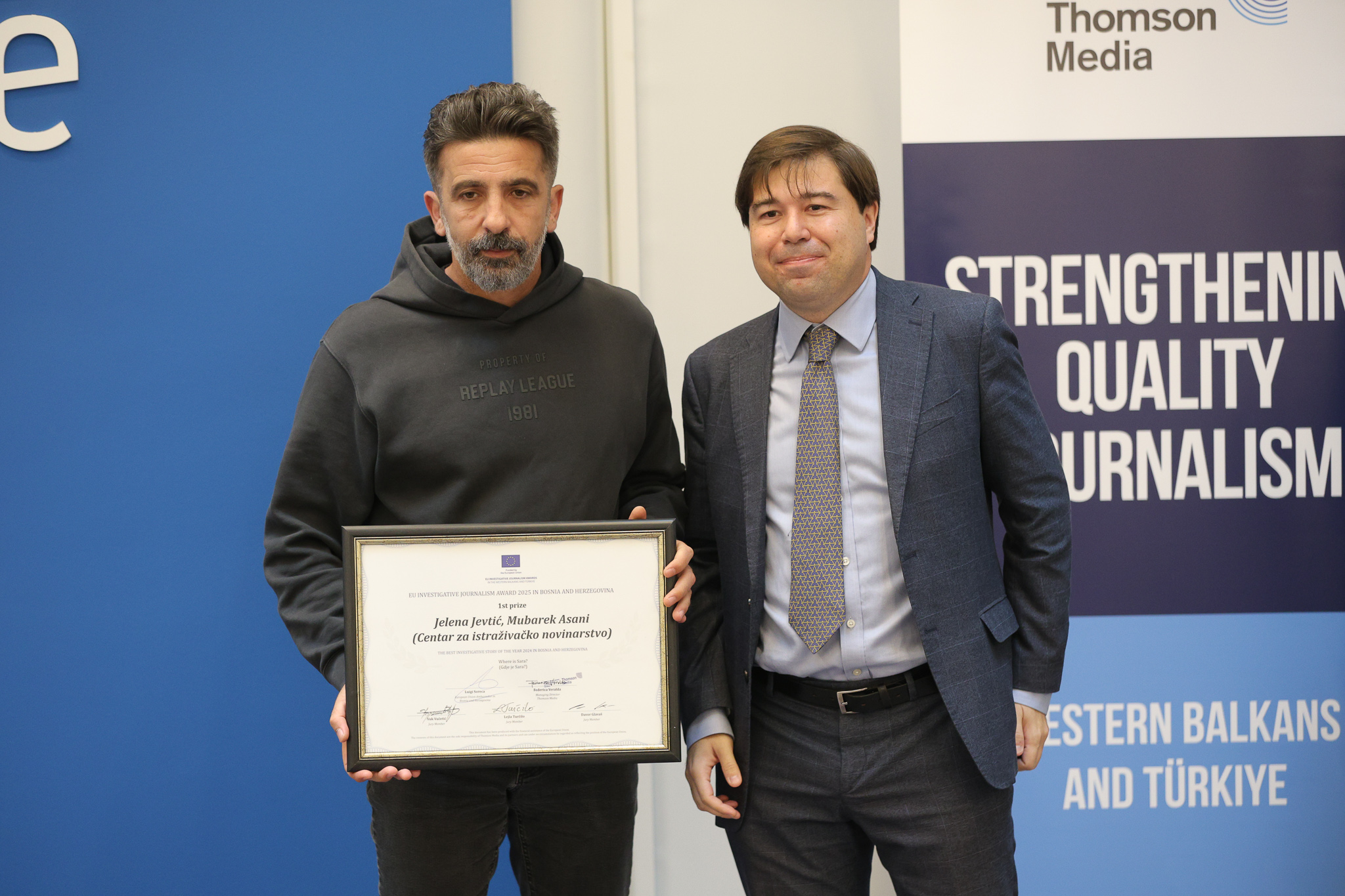
Jelena Jevtić holds a Journalism degree from the Faculty of Political Sciences at the University of Banja Luka. Before joining the Center for Investigative Reporting (CIN) in Sarajevo in 2017, she worked as a reporter for BNTV, the Helsinki Committee for Human Rights, the “Novi Talas” portal, TV Arena, Nezavisne novine, and Fokus. At CIN, Jelena worked as an investigative reporter, focusing on issues such as corruption, organized crime, abuse of office, and other social matters. She has also contributed to the development of CIN’s online databases aimed at promoting transparency and accountability in government institutions, particularly in areas such as asset declarations and public procurement.
Mubarek Asani is an investigative journalist and producer. He studied political science at the University of Sarajevo, Bosnia and Herzegovina. In 2003, he was awarded an EU scholarship for a one-year journalism study, which he graduated as the most successful television journalist. His thesis focusing on minorities rights in Bosnia and Herzegovina, was presented through a short documentary TV titled “Confession of the Shadows”. After graduation he was invited to be a lecturer at the same journalism study course in Sarajevo. During his career, Asani took over complex journalistic tasks such as those on drug trafficking, tobacco smuggling, terrorism, prostitution, judicial crime, election vote-trading, and illegal exploitation of natural resources. He has been working for the Center for Investigative Reporting (CIN) since 2007.
WeBalkans: How did you come across the story of Sara, and what was your process of investigation? This is a documentary piece that required you to be in proximity with your subjects (Sara’s parents), what kind of ethical boundaries did you have in mind in this process.
Jelena Jevtic & Mubarek Asani: The story found its way to us. After Aleksandra (the mother) had fought unsuccessfully with the institutions in search of her baby, after she had even reported the case to the prosecutor’s office and received no answers from their investigation, she contacted CIN based on someone’s recommendation. She told us a short version of her story during that first phone call. She was upset and exhausted from everything.
From the beginning, we knew this was a story that demanded sensitivity, depth, and time. Our investigative process began with months of background research—reviewing police reports and medical records to understand what had already been said and, more importantly, what had been left out.
By analyzing the documentation, we realized that the authorities, during their investigation, had focused mainly on the mother Aleksandra’s pregnancy, on the procedures applied during her stay at the University Clinical Center of Banja Luka, paying particular attention to the events and their timeline on the day of the birth. But what stood out to us was that no one in the investigation had asked the most obvious question: where is the baby?
For us, the events from the moment the hospital informed the father, Miloš, that the baby had died—the way they did it, why they did not inform the mother who was there in the hospital, lying in their ward, why they did not allow her to see her child, alive or dead, and, most strangely of all, how the hospital allegedly took it upon itself to bury the baby without the parents’ knowledge—all of that was deeply troubling.
According to procedure, the parents must give written consent for a burial. That did not happen in this case. The hospital, in cooperation with the city cemetery, buried the baby without the parents’ knowledge. We focused our investigation on that part of the story—and we proved they were not telling the truth. Moreover, we questioned the objectivity of the investigation itself, because you must admit it is unusual that an investigation would focus on hospital procedures and whether the mother was treated properly during her stay there, while completely ignoring the question of where the baby’s body was.
This was the shared point of the problem that brought us together with Sara’s parents, Aleksandra and Miloš. Building trust with them was a slow and careful process. We were constantly aware that for them, this was not just a story — it was their lived trauma.
We made it clear to them that their participation in the film was essential, that they could not set boundaries regarding what would be filmed or discussed, and that their real emotional states were crucial for the documentary—real, not staged or exaggerated. Every emotional moment you see from Aleksandra and Miloš in the film represents their genuine, everyday emotional experience of our investigative process—it was not directed or prearranged. The best example of this is the moment when we confront Aleksandra with the DNA analysis results after the exhumation of the second grave. Jelena and I already knew what the envelope contained—we knew the DNA results. But Aleksandra did not. We only told her to be ready at home because we were coming with the results and that we didn’t know what was inside. What Aleksandra goes through on camera after opening that envelope is real, raw, and true—it was not staged. Our goal was to show how systemic failures intersect in real lives.
Unfortunately, we still haven’t found Sara, but we proved that she was not buried, that the hospital and the city cemetery are concealing something related to this case, and we compelled the prosecutor’s office to reopen the investigation.
In the end, Sara became more than an investigation—it became an act of bearing witness, highlighting the urgent need for stronger mechanisms to protect children. The film Where Is Sara sparked a powerful response not only from the public but also from those responsible for law enforcement. The prosecutor’s office had to reopen the case immediately after the film was released. Some called it “the fastest reaction of a prosecutor’s office acting ex officio, based on a journalistic investigation.” Questions were raised and debates opened in local parliaments, demanding that the executive authorities finally resolve the case.
The greatest success we achieved through this investigation was precisely that—we forced the prosecutor’s office, after closing the initial investigation, to open a new one. And most importantly, today the prosecutor’s office, to close this case, must answer the question Where is Sara?
WeBalkans: What are your thoughts on the position of journalism at large in the region today, and especially of investigative journalism. In regions like Western Balkans, it seems like the need for independent investigative journalism is even more urgent, whereas pressure towards journalists and investigative journalism is at the same time higher and ever-more present. What are your thoughts on this?
Jelena Jevtic & Mubarek Asani: In the Western Balkans today, journalism finds itself in a paradoxical position: it’s simultaneously more necessary than ever and more fragile than ever. Watchdog institutions such as the judiciary, anti-corruption agencies or regulatory bodies, are either under political control or suffer from chronic underfunding and inefficiency.
That means investigative journalists have taken on the role of informal accountability mechanisms, uncovering corruption, organized crime links, and abuse of power that might otherwise never come to light. This responsibility puts enormous strain on small teams and independent outlets that are often under-resourced and face legal harassment and smear campaigns.
Jelena Jevtić holds a Journalism degree from the Faculty of Political Sciences at the University of Banja Luka. Before joining the Center for Investigative Reporting (CIN) in Sarajevo in 2017, she worked as a reporter for BNTV, the Helsinki Committee for Human Rights, the “Novi Talas” portal, TV Arena, Nezavisne novine, and Fokus. At CIN, Jelena worked as an investigative reporter, focusing on issues such as corruption, organized crime, abuse of office, and other social matters. She has also contributed to the development of CIN’s online databases aimed at promoting transparency and accountability in government institutions, particularly in areas such as asset declarations and public procurement.
Mubarek Asani is an investigative journalist and producer. He studied political science at the University of Sarajevo, Bosnia and Herzegovina. In 2003, he was awarded an EU scholarship for a one-year journalism study, which he graduated as the most successful television journalist. His thesis focusing on minorities rights in Bosnia and Herzegovina, was presented through a short documentary TV titled “Confession of the Shadows”. After graduation he was invited to be a lecturer at the same journalism study course in Sarajevo. During his career, Asani took over complex journalistic tasks such as those on drug trafficking, tobacco smuggling, terrorism, prostitution, judicial crime, election vote-trading, and illegal exploitation of natural resources. He has been working for the Center for Investigative Reporting (CIN) since 2007.
WeBalkans: How did you come across the story of Sara, and what was your process of investigation? This is a documentary piece that required you to be in proximity with your subjects (Sara’s parents), what kind of ethical boundaries did you have in mind in this process.
Jelena Jevtic & Mubarek Asani: The story found its way to us. After Aleksandra (the mother) had fought unsuccessfully with the institutions in search of her baby, after she had even reported the case to the prosecutor’s office and received no answers from their investigation, she contacted CIN based on someone’s recommendation. She told us a short version of her story during that first phone call. She was upset and exhausted from everything.
From the beginning, we knew this was a story that demanded sensitivity, depth, and time. Our investigative process began with months of background research—reviewing police reports and medical records to understand what had already been said and, more importantly, what had been left out.
By analyzing the documentation, we realized that the authorities, during their investigation, had focused mainly on the mother Aleksandra’s pregnancy, on the procedures applied during her stay at the University Clinical Center of Banja Luka, paying particular attention to the events and their timeline on the day of the birth. But what stood out to us was that no one in the investigation had asked the most obvious question: where is the baby?
For us, the events from the moment the hospital informed the father, Miloš, that the baby had died—the way they did it, why they did not inform the mother who was there in the hospital, lying in their ward, why they did not allow her to see her child, alive or dead, and, most strangely of all, how the hospital allegedly took it upon itself to bury the baby without the parents’ knowledge—all of that was deeply troubling.
According to procedure, the parents must give written consent for a burial. That did not happen in this case. The hospital, in cooperation with the city cemetery, buried the baby without the parents’ knowledge. We focused our investigation on that part of the story—and we proved they were not telling the truth. Moreover, we questioned the objectivity of the investigation itself, because you must admit it is unusual that an investigation would focus on hospital procedures and whether the mother was treated properly during her stay there, while completely ignoring the question of where the baby’s body was.
This was the shared point of the problem that brought us together with Sara’s parents, Aleksandra and Miloš. Building trust with them was a slow and careful process. We were constantly aware that for them, this was not just a story — it was their lived trauma.
We made it clear to them that their participation in the film was essential, that they could not set boundaries regarding what would be filmed or discussed, and that their real emotional states were crucial for the documentary—real, not staged or exaggerated. Every emotional moment you see from Aleksandra and Miloš in the film represents their genuine, everyday emotional experience of our investigative process—it was not directed or prearranged. The best example of this is the moment when we confront Aleksandra with the DNA analysis results after the exhumation of the second grave. Jelena and I already knew what the envelope contained—we knew the DNA results. But Aleksandra did not. We only told her to be ready at home because we were coming with the results and that we didn’t know what was inside. What Aleksandra goes through on camera after opening that envelope is real, raw, and true—it was not staged. Our goal was to show how systemic failures intersect in real lives.
Unfortunately, we still haven’t found Sara, but we proved that she was not buried, that the hospital and the city cemetery are concealing something related to this case, and we compelled the prosecutor’s office to reopen the investigation.
In the end, Sara became more than an investigation—it became an act of bearing witness, highlighting the urgent need for stronger mechanisms to protect children. The film Where Is Sara sparked a powerful response not only from the public but also from those responsible for law enforcement. The prosecutor’s office had to reopen the case immediately after the film was released. Some called it “the fastest reaction of a prosecutor’s office acting ex officio, based on a journalistic investigation.” Questions were raised and debates opened in local parliaments, demanding that the executive authorities finally resolve the case.
The greatest success we achieved through this investigation was precisely that—we forced the prosecutor’s office, after closing the initial investigation, to open a new one. And most importantly, today the prosecutor’s office, to close this case, must answer the question Where is Sara?
WeBalkans: What are your thoughts on the position of journalism at large in the region today, and especially of investigative journalism. In regions like Western Balkans, it seems like the need for independent investigative journalism is even more urgent, whereas pressure towards journalists and investigative journalism is at the same time higher and ever-more present. What are your thoughts on this?
Jelena Jevtic & Mubarek Asani: In the Western Balkans today, journalism finds itself in a paradoxical position: it’s simultaneously more necessary than ever and more fragile than ever. Watchdog institutions such as the judiciary, anti-corruption agencies or regulatory bodies, are either under political control or suffer from chronic underfunding and inefficiency.
That means investigative journalists have taken on the role of informal accountability mechanisms, uncovering corruption, organized crime links, and abuse of power that might otherwise never come to light. This responsibility puts enormous strain on small teams and independent outlets that are often under-resourced and face legal harassment and smear campaigns.
Please wait while your video is being uploaded...
Don't close this window!