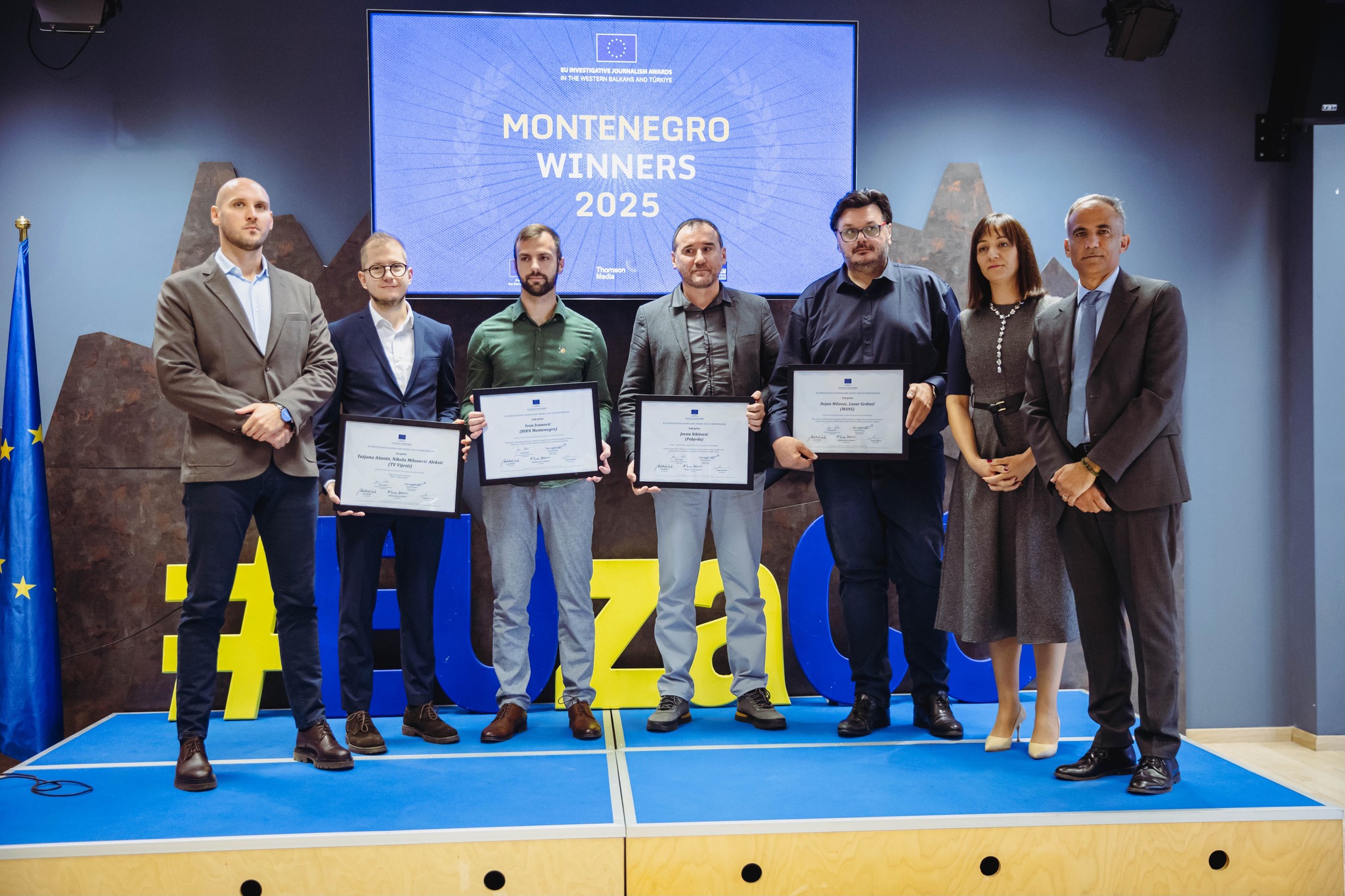
Interview with Tatjana Ašanin and Nikola Milosavić Aleksić
Over the past few weeks, the Western Balkan countries have been celebrating investigative journalism. Professional juries across Serbia, Bosnia and Herzegovina, Montenegro, Albania, North Macedonia, and Kosovo have gathered to evaluate some of the most compelling investigative journalism pieces.
We spoke to all first-prize winners across the region, and will publish the interviews with them in series. Through this series that we have titled “EU Celebrates Investigative Journalism in the Western Balkans” we want to celebrate these exemplary journalists and get to know more about their investigation practices, the urgency of addressing these issues in their country as well as their reflections on the position of investigative journalism in their country and in the region at large.
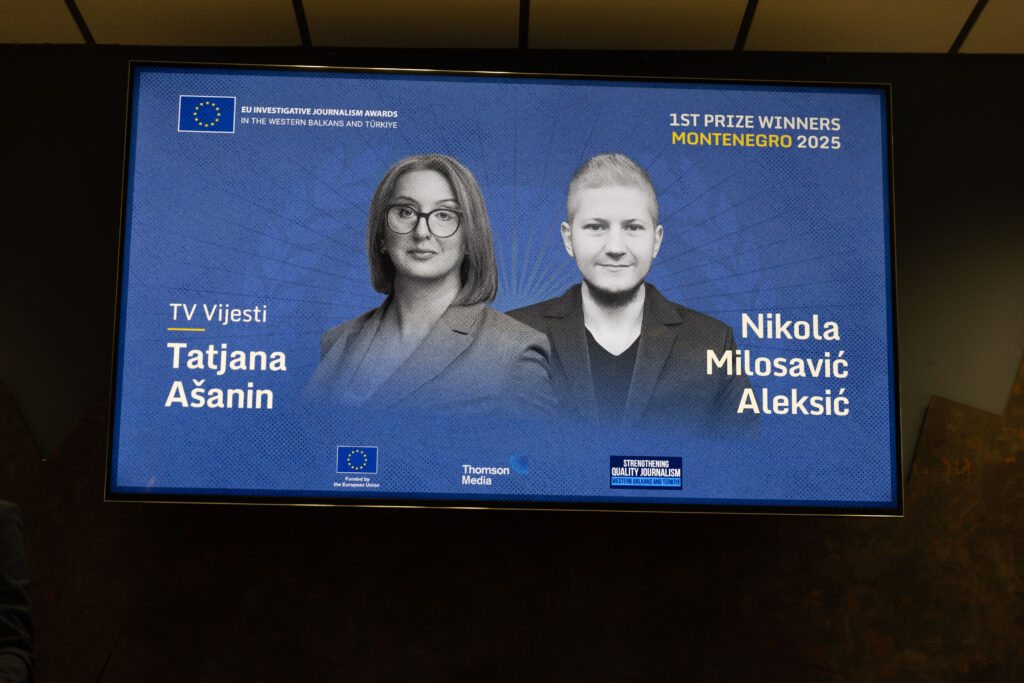
In Montenegro, jury members Lamija Alečković, Marijana Camović Veličković, and Leila Bičakčić crowned Tatjana Ašanin and Nikola Milosavić Aleksić as winners for the second year in a row. Their documentary Target: The State of Relatives — different in topic from last year’s Murky Waters yet equally of high public interest — investigates how relatives of high-ranking state and local officials from ruling parties obtained well-paid public administration jobs after the 2020 elections.
Tatjana Ašanin is a veteran journalist at TV Vijesti. She first became known to audiences through Radio Antena-M, after which she moved to TV Vijesti to serve as Editor-in-Chief. Taking over when the station was on the brink of bankruptcy, she transformed it into the most-watched and trusted television station in the country. She held that position for nearly a decade. Today, she is the editor and host of the show Nedjelja u retrovizoru (Sunday in the Rearview Mirror).
Nikola Milosavić Aleksić is an investigative journalist with extensive international experience. He began his career in Slovenia as a correspondent for Planet TV covering the Slovenian coast. He continued his career at TV N1 – CNN exclusive news channel affiliate in Belgrade as an investigative journalist and producer, where he published numerous exclusive stories, including the revelation of secret contracts between the State of Serbia and the Italian car manufacturer FIAT, which had been classified for 15 years. After N1 Belgrade, he moved to TV Vijesti in Montenegro, working as an investigative journalist and editor of the investigative program. He has produced three investigative documentaries and is a two-time recipient of the EU Award for Investigative Journalism. He later moved from TV Vijesti to Al Jazeera, serving as their correspondent from Slovenia until the network ceased its operations in that specific market. He is currently employed at N1 Slovenia.
WeBalkans: What was your process of investigation for the piece “Target: The State of Relatives”. This is quite sensitive for a region like ours where employment of relatives in public institutions is ‘a public secret’. What were the risks you undertook in your process? A short overview of the piece and your investigative process is what we are looking for with this question.
Tatjana Ašanin & Nikola Milosavić Aleksić: It has always been known that nepotism is a cancer of Montenegrin society, but the sheer scale of it remained unknown. When the government changed for the first time in Montenegro’s modern history after 30 years, the new political establishment promised a meritocracy. The reality was the exact opposite: not only was nepotism not eradicated, it was exacerbated by more than 5,000 new hires in public administration and state-owned enterprises.
Following our initial suspicions, the process involved hundreds of meetings with various sources across the entire country from north to south, east to west. Once we obtained the information, we conducted a thorough verification of all data and collected employment contracts. It was incredibly difficult to prove family ties beyond the immediate nuclear family, but we executed that aspect flawlessly.
The biggest obstacle was that state-owned companies were violating the Law on Free Access to Information. The director of the national power company even admitted on camera that they were consciously breaking the law by refusing to provide information to the media. This necessitated a longer production period as we had to gather evidence from secondary and tertiary sources. Securing interviewees was also a grueling part of the process, as potential subjects tried to impose conditions that we, as professionals, could not accept.
The film treats the subject of nepotism non-selectively, covering all parliamentary political parties, including those representing national minorities. In the film itself, we displayed over 100 employment contracts belonging to family members of the highest state officials, providing direct proof of nepotism multiple times. Although the Prosecutor’s Office announced an investigation, it has yet to materialize.
WeBalkans: This is the second time you are awarded the EU Investigative Journalism Award, your collaboration for “In Murky Waters”, was also awarded last year. How do you feel about that, and most importantly, what was it like to collaborate again? Do you feel like you share a mission in your work?
Tatjana Ašanin & Nikola Milosavić Aleksić: There is a significant gap in age and experience between us, but we are united by fundamental journalistic values: facts, truth, exclusivity, and most importantly results. When I came to the initial meeting with Tatjana, presented the evidence I had for the first film, and asked if she wanted to make a documentary, she said yes instantly, without hesitation.
The second film we made was her initiative, focusing on the abuse of the secret service for political purposes. The third film followed logically from the first two. In a world where free media is being suffocated and journalism is dying out, collaborating with Tatjana was exceptionally productive. Our work began as a partnership between two ambitious professionals and evolved into a sincere friendship, which is a rarity in the world of journalism.
WeBalkans: What are your thoughts on the position of journalism at large in the region today, and especially of investigative journalism. In regions like Western Balkans, it seems like the need for independent investigative journalism is even more urgent, whereas pressure towards journalists and investigative journalism is at the same time higher and ever-more present. What are your thoughts on this?
Tatjana Ašanin & Nikola Milosavić Aleksić: Journalism in the region is dying, if it ever truly existed. The only two free television stations in Serbia are under immense pressure from a government attempting to shut them down and ban them, doing so both publicly and secretly through backroom deals with media owners. Specifically, Serbian President Aleksandar Vučić, aside from labeling journalists as terrorists, foreign mercenaries, and traitors, has arranged to take political control over media outlets belonging to United Media. This was revealed in a secret recording published by the international investigative network OCCRP.
United Media owns outlets in Serbia, Bosnia and Herzegovina, Montenegro, Croatia, Slovenia, Bulgaria, Greece, and beyond. In almost every market where they operate, their media are examples of professionalism, yet they often stand alone in that status. The changes and scandals shaking United Media suggest that the Serbian government aims to control media across the entire region and extinguish the last independent voices in Serbia, Montenegro, and Bosnia and Herzegovina. The current regime is already attempting to subjugate the region through franchises like Euronews and Newsmax, which are owned by the state firm Telekom Srbija (Telecom Serbia). Furthermore, major professional outlets like Al Jazeera and Voice of America have largely neglected our region recently.
Journalists in the Western Balkans are targets of attacks, threats, and physical violence; a significant number live under 24-hour police protection. Consequently, investigative journalism in our area is at the lowest point in its history. By definition, investigative journalism targets crime, corruption, and the abuse of power, which is exactly why it bothers the political elite. The leaders of the Western Balkans have not moved far from the philosophy of Louis XIV and the maxim “I am the State”.
Our role as journalists is to prevent the total control of institutions by individuals and to promote democratic values, freedom, equality, and love. The Western Balkans is a region scarred by national hatred, and the only cure for this disease is journalism that strives for reconciliation, emancipation, and equality. Either we succeed, or the entire region will remain an isolated backwater on the map of Europe.
WeBalkans: What was your process of investigation for the piece “Target: The State of Relatives”. This is quite sensitive for a region like ours where employment of relatives in public institutions is ‘a public secret’. What were the risks you undertook in your process? A short overview of the piece and your investigative process is what we are looking for with this question.
Tatjana Ašanin & Nikola Milosavić Aleksić: It has always been known that nepotism is a cancer of Montenegrin society, but the sheer scale of it remained unknown. When the government changed for the first time in Montenegro’s modern history after 30 years, the new political establishment promised a meritocracy. The reality was the exact opposite: not only was nepotism not eradicated, it was exacerbated by more than 5,000 new hires in public administration and state-owned enterprises.
Following our initial suspicions, the process involved hundreds of meetings with various sources across the entire country from north to south, east to west. Once we obtained the information, we conducted a thorough verification of all data and collected employment contracts. It was incredibly difficult to prove family ties beyond the immediate nuclear family, but we executed that aspect flawlessly.
The biggest obstacle was that state-owned companies were violating the Law on Free Access to Information. The director of the national power company even admitted on camera that they were consciously breaking the law by refusing to provide information to the media. This necessitated a longer production period as we had to gather evidence from secondary and tertiary sources. Securing interviewees was also a grueling part of the process, as potential subjects tried to impose conditions that we, as professionals, could not accept.
The film treats the subject of nepotism non-selectively, covering all parliamentary political parties, including those representing national minorities. In the film itself, we displayed over 100 employment contracts belonging to family members of the highest state officials, providing direct proof of nepotism multiple times. Although the Prosecutor’s Office announced an investigation, it has yet to materialize.
WeBalkans: This is the second time you are awarded the EU Investigative Journalism Award, your collaboration for “In Murky Waters”, was also awarded last year. How do you feel about that, and most importantly, what was it like to collaborate again? Do you feel like you share a mission in your work?
Tatjana Ašanin & Nikola Milosavić Aleksić: There is a significant gap in age and experience between us, but we are united by fundamental journalistic values: facts, truth, exclusivity, and most importantly results. When I came to the initial meeting with Tatjana, presented the evidence I had for the first film, and asked if she wanted to make a documentary, she said yes instantly, without hesitation.
The second film we made was her initiative, focusing on the abuse of the secret service for political purposes. The third film followed logically from the first two. In a world where free media is being suffocated and journalism is dying out, collaborating with Tatjana was exceptionally productive. Our work began as a partnership between two ambitious professionals and evolved into a sincere friendship, which is a rarity in the world of journalism.
WeBalkans: What are your thoughts on the position of journalism at large in the region today, and especially of investigative journalism. In regions like Western Balkans, it seems like the need for independent investigative journalism is even more urgent, whereas pressure towards journalists and investigative journalism is at the same time higher and ever-more present. What are your thoughts on this?
Tatjana Ašanin & Nikola Milosavić Aleksić: Journalism in the region is dying, if it ever truly existed. The only two free television stations in Serbia are under immense pressure from a government attempting to shut them down and ban them, doing so both publicly and secretly through backroom deals with media owners. Specifically, Serbian President Aleksandar Vučić, aside from labeling journalists as terrorists, foreign mercenaries, and traitors, has arranged to take political control over media outlets belonging to United Media. This was revealed in a secret recording published by the international investigative network OCCRP.
United Media owns outlets in Serbia, Bosnia and Herzegovina, Montenegro, Croatia, Slovenia, Bulgaria, Greece, and beyond. In almost every market where they operate, their media are examples of professionalism, yet they often stand alone in that status. The changes and scandals shaking United Media suggest that the Serbian government aims to control media across the entire region and extinguish the last independent voices in Serbia, Montenegro, and Bosnia and Herzegovina. The current regime is already attempting to subjugate the region through franchises like Euronews and Newsmax, which are owned by the state firm Telekom Srbija (Telecom Serbia). Furthermore, major professional outlets like Al Jazeera and Voice of America have largely neglected our region recently.
Journalists in the Western Balkans are targets of attacks, threats, and physical violence; a significant number live under 24-hour police protection. Consequently, investigative journalism in our area is at the lowest point in its history. By definition, investigative journalism targets crime, corruption, and the abuse of power, which is exactly why it bothers the political elite. The leaders of the Western Balkans have not moved far from the philosophy of Louis XIV and the maxim “I am the State”.
Our role as journalists is to prevent the total control of institutions by individuals and to promote democratic values, freedom, equality, and love. The Western Balkans is a region scarred by national hatred, and the only cure for this disease is journalism that strives for reconciliation, emancipation, and equality. Either we succeed, or the entire region will remain an isolated backwater on the map of Europe.
Please wait while your video is being uploaded...
Don't close this window!