EU-Western Balkans summit 2025


EU-Western Balkans summit 2025
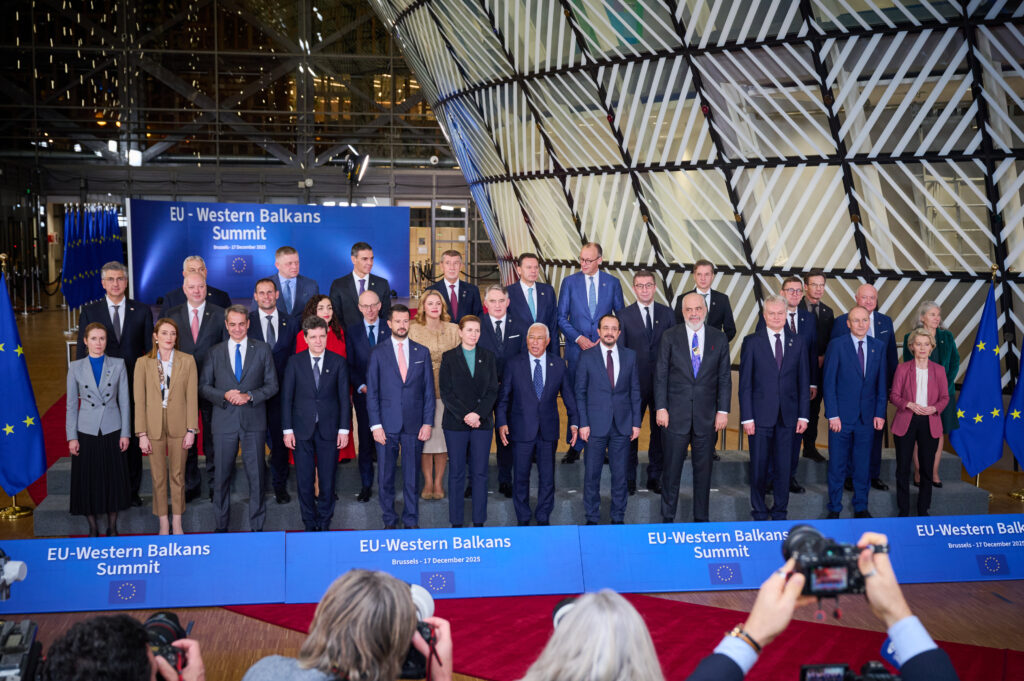
The EU and Western Balkans meeting, chaired by President António Costa, provided an opportunity to demonstrate and reconfirm the strength of the EU-Western Balkans strategic relationship and the benefits it brings to citizens.
“Today’s summit has delivered a clear message: we firmly support the Western Balkans’ future in the European Union. Enlargement remains central to our shared objectives.”
President Costa
The President of the European Council represented the EU at the summit together with the President of the Commission. High Representative Kaja Kallas also attended.
A declaration was issued at the end of the EU-Western Balkans summit. All attending partners from the region have aligned with it.
Strategic partnership between the EU and the Western Balkans
The summit highlighted the importance of the close political and economic relationship between the EU and Western Balkans partners, especially in the current geopolitical context and the need for ever-stronger ties between the EU and the Western Balkans.
The EU reaffirmed its commitment to the European Union membership perspective of the Western Balkans, and welcomed the progress achieved in the enlargement process.
“The acceleration of the accession process, based on credible reforms by partners, fair and rigorous conditionality and the principle of own merits, is in our mutual interest.”
Brussels declaration
The summit underlined the importance of tangible progress on reforms, alignment with the ‘acquis’, regional cooperation, good neighbourly relations and reconciliation.
The EU welcomed the Western Balkans partners’ commitment to upholding European values and principles, in line with international law, the primacy of democracy, fundamental rights and values and the rule of law, and expects them to demonstrate this in both words and action by taking ownership and implementing the necessary reforms, notably in the area of fundamentals.
Gradual integration and the Growth Plan
The EU is committed to bringing the Western Balkans partners closer to the EU during the enlargement process.
“Enlargement is a deeply transformational process. Socioeconomic convergence will anchor their future in the European Union.”
President Costa
Their gradual integration, carried out in a reversible and merit-based manner, is ongoing in several policy areas, preparing the ground for accession and bringing concrete benefits for citizens.
The EU is expected to welcome concrete progress on the gradual integration of the Western Balkans partners into the EU single market, notably through the Growth Plan for the Western Balkans.
Launched in 2023, the Growth Plan aims to further integrate the Western Balkans partners into the EU single market, advance regional economic cooperation, as well as to incentivise the necessary EU-related reforms by providing up to €6 billion for reforms and investments.
“EU calls for making the most of the unprecedented opportunities provided by the Growth Plan through timely implementation of reforms.”
Brussels declaration
The Growth Plan has the potential to accelerate economic growth in the region over the next decade and to speed up socioeconomic convergence between the Western Balkans and the EU, provided that the partners implement the EU-related reforms.
The EU is the Western Balkans’ primary and most reliable partner. It is the region’s main trading partner, investor and donor.
Foreign affairs and security and defence
The EU underscored the importance of the alignment with the EU’s Common Foreign and Security Policy (CFSP), including the implementation and enforcing of the EU’s restrictive measures and countering circumvention. This remains a strong expression of a partner’s strategic choice. The EU also welcomed partners’ contributions to the EU’s CDSP missions and operations.
EU and Western Balkans leaders reiterated that they stand united in their unwavering support for and solidarity with Ukraine.
Leaders also discussed cooperation:
- in the areas of security and defence, notably through the European Peace Facility and the launch of security and defence dialogues
- in building resilience to hybrid and cyber threats to counter foreign information manipulation and interference
Connectivity
The EU welcomed the strengthening of connectivity within the region and with the EU in energy, and transport.
The EU will continue to support ongoing efforts to diversify the sources and routes of energy supplies, and to contribute to the energy transition in the Western Balkans.
Cooperation in migration management and combating organised crime and corruption
The EU and the Western Balkans have a shared responsibility for addressing common challenges.
While progress has been made, further action is needed by the Western Balkans partners to fully align their visa policy with the EU, to combat the smuggling of migrants and trafficking in human beings, and to further strengthen border management, asylum and reception systems and returns to countries of origin.
Leaders also discussed joint efforts on the fight against corruption, drug trafficking and organised crime, as well as preventing and countering terrorism and violent extremism.
Background information
The summit is part of the implementation of the European Council’s 2024-2029 strategic agenda.
Regular EU-Western Balkans summits have been held since 2018. The latest summit between EU and Western Balkans leaders took place in Brussels in December 2024.
The next summit will take place in June 2026 in Montenegro.